

Gros Point de Venice, or simply Point de Venice, is a type of needlepoint lace produced in Venice from the seventeenth century. It is characterised by its floral patterns and other floral motifs set in relief, hence its other name, 'Gros' Point de Venice. Venetican lace is often described as the origin of many types of French lace, as for instance Point de France and Point de Sedan.
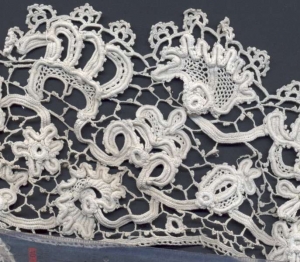
Irish crochet or Irish crochet lace was developed in Ireland in the mid-nineteenth century. It imitates Venetian point laces. It includes separately crocheted motifs, which are brought together and provisionally basted to a ground before being joined with chains and picots, after which the ground is removed.
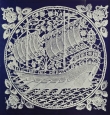
Aemilia Ars needlepoint lace (It. Punto in Aria di Bologna) is linked to the establishment in 1898 of the Aemilia Ars Society, in Bologna, Italy. The Foundation propagated the revival of the old crafts of the Emilia region, including that of embroidery and lace.

The Textile Museum at St. Gallen reflects the intriguing history of the huge local embroidery industry that developed here, mainly following the invention and introduction of hand machine embroidery machines in the early nineteenth century.


Gota work, or gotapatti, is an Indian embroidery technique that originated in Rajasthan, Western India, where it is still being produced. Basically, gota work is an appliqué technique that fastens silver or gold (coloured) ribbons (gota) onto the ground material, with the edges of the ribbon sewn down, thus creating elaborate designs.

The collection of the Museum Volkenkunde, Leiden (the Netherlands) is for a large part based on the Koninklijk Kabinet van Zeldzaamheden (‘the Royal Cabinet of Rarities’), which was established in 1816 in The Hague, the Netherlands. The Kabinet was in its turn built on a general royal collection of objects and a private collection of Chinese artefacts. The Kabinet closed in 1883 and its collection was moved to Leiden.

The cheongsam is regarded as the ‘standard’ dress for Chinese women from the 1930's until the 1960's. During this time it was popular in China’s main cities such as Shanghai as well as Hong Kong, Taiwan and among the Chinese diaspora throughout the world. They were often embroidered, either by hand or with a machine. There have been attempts to make the cheongsam into the national dress of China.
More...
The Language of Threads is a novel published in 2000, and set in Hong Kong in the 1930's. It features Pei, who works initially as a saitong (washer and ironer of richly embroidered cheongsams), and then later she sets up a tailoring business. Here she starts to embroider the story of her life in silk.

Gail Tsukiyama (1957) is an award-winning Asian-American novelist, whose work focuses on the lives of Chinese women, often textile workers. Her debut novel Women of the Silk (published in 1991) is set in a silk factory in 1920's rural China, where the young girl Pei is working in a silk house. The book includes details of the mutual aid societies that were organized by Chinese women silk workers.

In 1947 Cecil Beaton, one of the most famous fashion (and war) photographers of the twentieth century, wrote a thank you letter to Mr. Lock of what later became the firm of Hand & Lock, an important British embroidery company based in London.
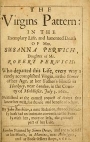
The Virgins Pattern: in the exemplary life, and lamented death of Mrs. Susanna Perwich .... is a mid-seventeenth century printed eulogy about the life and death of Susanna Perwich (1636-1661), a Quaker from London. She was the daughter of Robert Perwich of Aldermanbury, London.