
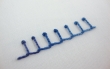
The knotted buttonhole stitch looks very much like a blanket stitch and is often used to fasten the edges of a buttonhole, since it is much stronger that the buttonhole stitch because of the knots.
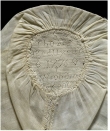
Hollie point (or holy point) is a form of flat needlepoint lace with rows of hollie stitches: knotted buttonhole stitches worked over horizontal, stretched threads. Hollie point was popular in England from the seventeenth to the early nineteenth centuries.

Hollie stitch is a form of lace stitch used to create hollie or holy point lace, which was popular in England in the eighteenth and nineteenth centuries. The stitch, according to Mary Thomas and following her description, is partially detached from the ground material and takes the form of a series of connected, small knots.
More...

Limerick run lace is a form of embroidered net lace. It uses a machine-made net (tulle) and a running stitch for decoration. It can be classed as a form of needlerun. It allegedly originated in Nottingham. It is very similar to Kells lace.
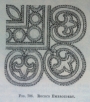
In the late nineteenth century, there were two forms of Rococo work in Northern Europe. The first consisted of silk ribbons being sewn to a satin or velvet foundation (China ribbon work), while the second, basically a form of cutwork, was described by Caulfeild and Saward as being a variation of Roman work.
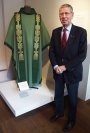
The wearing of the stole on the outside of a chasuble or cope by Catholic clergy is relatively recent and is accredited to the Dutch Atelier Stadelmaier company, based in Nijmegen: In the 1960's the atelier devised a new style of liturgical outfit known as the Nijmegen model (Nijmeegs model), which included an embroidered stole that was worn on the outside, over the chasuble or cope.

The Atelier Stadelmaier, Nijmegen (the Netherlands), was set up in 1930 and eventually became one of the world's largest producers of liturgical clothing. It closed down in 2010. The company was set up by Arthur Stadelmaier (born in Germany; 1901-1981) and his wife, Magdalena Stadelmaier-Glässner (Poland; 1906-1989), who came to Nijmegen in the 1920's.