

Suf embroidery is a form of counted thread embroidery practiced nowadays in the Kutch region of Gujarat, western India, and beyond. It is characterized by a type of economy stitch worked from the back. The patterns are generally based on a triangle or ‘suf’, and are geometric, symmetrical and very detailed.
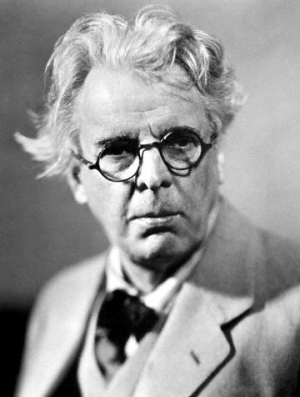
Aedh wishes for the cloths of heaven is a poem by the Irish poet, William Butler Yeats (1865-1939). It was first published in 1899 in The Wind Among the Reeds. The title of the poem is sometimes shortened to Cloths of Heaven. The narrator of the poem is Aedh, who appears in various poems. Aedh was regarded by Yeats as being a pale, lovelorn man who languishes in love.

There is a medieval cope associated with St. Boniface. It is now in Museum Catharijneconvent, Utrecht, The Netherlands (acc. no. ABM t2341). It is sometimes described as being embroidered. However, no decorative needlework appears to have survived. The museum has dated the ground cloth of the cope to between AD 1190-1209 and suggests an Eastern Mediterranean (possibly Egypt) origin.
George Hewitt Myers (1875-1957) was an American forester and philanthropist who was the heir to the Bristol-Myers pharmaceutical fortune. He started to collect carpets and textiles in the 1890’s with a number of Turkish and Caucasian village rugs that were originally bought for his room at Yale University.

The Textile Museum (TM), Washington, DC (USA), was founded in 1925 in the home of the American philanthropist George Hewitt Myers (1875-1957), who was also a well-known carpet and textile collector. The home of Myers at 2320 S St. NW was commissioned in 1912 from the architect John Russell Pope, who also designed the Jefferson Memorial, the National Archives building and part of the National Gallery of Art.

The Museum Catharijneconvent in Utrecht is the Dutch national museum for Christian art and heritage. It was opened in 1979. In addition to an outstanding collection of Roman Catholic and Protestant sculptures, paintings and books, the Museum houses one of the world’s most important reference collections of Dutch late medieval church vestments.

Ruy Gonzáles de Clavijo (d.1412) was the Castilian ambassador to the court of Timur (1336-1405), the founder of the Timurid empire. From 1403 he travelled for King Henry III (1379-1406) of Castile from Spain to Iran and further east to Samarkand, where he arrived on 8th September 1404. The Castilians left Samarkand again on 21st November 1404 and returned in Spain in 1406.

During the Second World War (1939-1945), rationing was applied in the UK and other countries, for many essential items, including clothing, food, paper, petrol and soap. People were issued with a variety of ration cards/coupons (clothing coupons, butter coupons, etc). When something was purchased a set number of coupons were stamped in order to cancel them. Rationing in Britain was only officially stopped in 1954.

In 1631, John Taylor published The Needles Excellency. A New Booke wherein are divers Admirable Workes wrought with the Needle, Newly invented and cut in Copper for the pleasure and profit of the industrious. The designs included in the book are preceded by a long poem and a series of five sonnets, all relating to the decorative art of the needle. Text and spelling follow the 1631 edition. GV
Flat quilting is an American term sometimes used to describe a form of quilting whereby only two pieces of cloth are sewn together.
More...
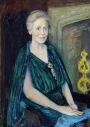
Rachel Kay-Shuttleworth was the daughter of Ughtred Kay-Shuttleworth (1844-1939) and Blanche Marion Kay-Shuttleworth (née Parish). The Hon. Rachel Kay-Shuttleworth's father was the 1st Baron Shuttleworth, who held various ministerial appointments, including that of Under-Secretary of State for India.

Gawthorpe Hall, Lancashire (England), is an Elizabethan building from AD 1600. For many centuries the Hall belonged to the Shuttleworth family. The Hall's last private owner was Rachel Kay-Shuttleworth (1886-1967), who built up a large collection of British garments as well as embroidery, lace, quilts, printed and woven textiles.

Cyclope neritea is a marine gastropod mollusc, and more specifically a species of sea snail that belongs to the Nassariidae family. The shell is similar in appearance to the whelk. C. Neritea lives in the Atlantic off Europe, in the Mediterranean Sea and the Black Sea. A Mesolithic example of the use of C. neritea shells being used for decorating garments comes from the site of Vlasac (Serbia) and dates to about 6500 BC.

The pharyngeal teeth of various types of fish have been used by many communities for decorating clothing. These teeth are located at the back of the fish’s mouth. Often the teeth were removed from the jaw during the process of cleaning and cooking of the fish. The teeth were then perforated, so they could be used as jewellery or as decoration on garments.