
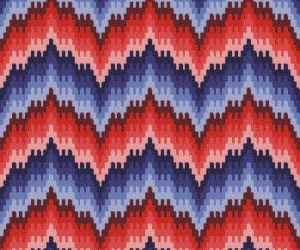
in Italy, the flame stitch is known as Punto unghero (‘Hungarian Point’), suggesting that this particular embroidery style was regarded as originating from Hungary. However, in English the term ‘Hungarian Point’ generally refers to a diamond-shaped stitch also called the Hungarian point stitch.
The Hungarian stitch, also called the Hungary stitch, is the name sometimes used for the flame stitch, but also for an upright form of the (diagonal) mosaic stitch.

Martha Edlin’s pin cushion is an object (7.5 x 6.3 cm) decorated with Florentine work. The pin cushion dates to around 1670/1680 and was made by an English girl called Martha Edlin (1660-1725). The front of the pin cushion is made from a piece of Florentine work in shades of blue and pink silk, using a flame stitch.
More...

Florentine work is a type of counted thread embroidery consisting of a series of straight stitches laid out in a specific, geometrical pattern to produce one or more motifs. It should be noted that the term Florentine work can refer to both the embroidery technique and the finished appearance of the work.

Bargello (or bargello work) is an American term for Florentine work. The name bargello originates from the Bargello Palace, Florence (Italy), where there are a series of seventeenth century chairs upholstered with canvas embroidery in this technique. It should be noted that the term bargello can refer to both the embroidery technique and the finished appearance of the work.
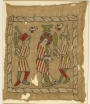
A fourteenth century embroidered panel from Lower Saxony, in what is now Germany, depicts a haloed figure, perhaps representing Christ or a saint. He is tied to a pole and is being beaten with a whip and club by two men wearing striped garments and parti-coloured hoses and shoes. There is a cup-like object (possibly the top of the column) above the haloed figure, and two birds.

The kloster block constitutes the foundation of Hardanger embroidery. It is worked with satin stitches or straight stitches. Five of these stitches are made to cover four even-weave fabric threads. The block designs thus created are placed along the border of the area that is cut away. The stitches of the kloster blocks serve to hold the threads of the uncut parts of the fabric together.