
A couching stitch fastens the laid thread to the ground material, using a couching thread. WV
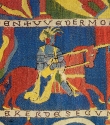
Kloster stitch is a form of couching used during the medieval period in Northern Europe (especially in what is now Germany). The Kloster stitch is especially associated with monastic establishments (known in German as a Kloster), hence the name of the stitch. It is a form of a single thread couching stitch, which is now also called Bokhara couching.

Pakko work is carried out by women of the Sodha, Rajput and Meghwal communities in the Kutch area of Gujarat, Northwest India. The motifs are generally geometric and floral, sometimes with stylized figures of peacocks or scorpions. The motifs are traditionally first drawn with mud, and then worked in maroon or red, dark green, white, or yellow, often with buttonhole stitch. Outlining is done in black, white or yellow, using a chain stitch.

The Peking knot is characteristic for much of Chinese traditional embroidery in silk, whereby rows of these fine stitches are used to fill in the motifs. Other, more romantic names for this stitch are the blind stitch and the forbidden stitch.

The region of Bereg lies in what is now northeastern Hungary and the adjoining parts of Ukraine. Its recent history is complicated. Until the fall of the Austro-Hungarian Empire in 1918, the capital of the region was Berehove (Beregszász). In 1920 much of the region was ceded to Czechoslovakia, with the southern part remaining in Hungary.
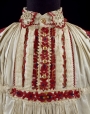
The Central European country of Hungary has a tradition of embroidery that goes back to at least the twelfth century and probably much before. One of the oldest surviving pieces of Hungarian embroidery is the so-called Coronation Mantle of King Stephen (r: 1001-1038), which is now in the National Museum of Hungary, Budapest.

Kloster Lüne (Lüne Abbey) is a medieval abbey in Lüneburg, in the German state of Lower Saxony. The abbey was founded in AD 1172 by a woman called Hildeswidis von Markboldestorp. It would appear that the monastic group was originally a chapter of canonesses and that it was not until about a hundred years later that it became a convent/abbey for Benedictine nuns.
More...
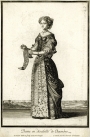
Dame en désabillé de chambre is the title of a print housed in the British Museum, which shows a woman holding a piece of embroidery in her hands. The print dates to about 1675. The woman is shown wearing a long apron that appears to be decorated with lace or whitework embroidery of some kind. She is holding a needle in her right hand and a long band with a stylised floral motif in her left hand.

The British Museum in London keeps a square of cotton cloth with a printed embroidery design. The print dates to the 1980's and was purchased in Sierra Norte de Puebla, in southeastern Mexico. The cloth is 42 x 48 cm in size.

A pulpit is the raised stand in a Christian church that is used during a liturgical service for sermons, readings, and so forth. A pulpit fall is a piece of cloth that hangs down in front of the pulpit. The pulpit fall is often decorated with embroidery of some kind and may come in a variety of different colours, depending on the time of the (liturgical) year and the occasion (a funeral, for example, may have a black pulpit fall).

During the 2012 renovations of the Sandys Row synagogue, Spitalfields, London, an embroidered bimah cover was found in the building’s cellar. A bimah is the elevated platform in the centre of a synagogue and is used to support the Torah while it is being read aloud to the congregation.