
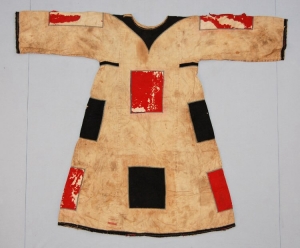
The so-called Mahdi tunics (jibba), decorated wih appliqué, were worn by the followers of Mohammad Ahmad bin Abd Alla (1844-1885). He was a Sufi sheikh from the Sudan who in 1881 proclaimed himself the Mahdi (messianic redeemer of the Islamic faith). This took place at a time of growing local resentment against the policies of the Ottoman-Egyptian rulers and the growing power of the British.
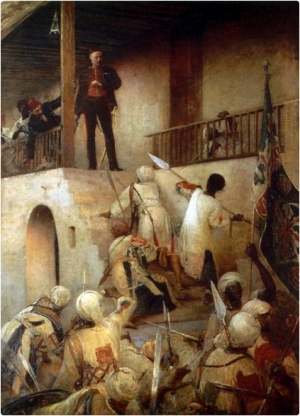
Mohammad Ahmad bin Abd Alla (1844-1885) was a Sufi sheikh in Sudan who proclaimed himself the Mahdi in 1881. The rise of the Mahdi took place during a period of growing local resentment against the policies of the Ottoman-Egyptian rulers and the growing power of the British. Mohammad Ahmad used the messianic beliefs of the time to propagate a ‘purer’ Islamic state.
In mid-eighteenth century Northern Europe and North America, it was not uncommon for a small, circular shape of cloth (c. five cm in diameter), sometimes mounted on a piece of card, to be placed between a watch case and a pocket watch in order to protect the watch glass.
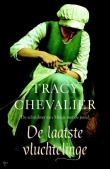
The Last Runaway is a novel by the American author, Tracy Chevalier. Its main themes are quilting and head coverings (millinery). It was published in 2013 and is the author's seventh book. The novel is set in Ohio (USA) in the 1850's. The main character is Honor Bright, an English Quaker, who expresses herself through quilt making. She is involved in the Underground Railroad network, which helped slaves escaping to freedom.

Tracy Chevalier is an American author of historical fiction. She was born in Washington D.C., USA. In 1983 she moved to England. Chevalier has a degree in English from Oberlin College (1984). She now lives in London. Chevalier is most famous for her second novel, Girl with a Pearl Earring (1999).
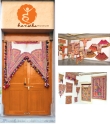
The Hansiba Museum is a traditional crafts museum in Radhanpur, in the western Indian province of Gujarat. The museum was opened to the public in April 2012. The museum is organized and operated by embroiderers of the Self-Employed Women’s Association (SEWA). It is intended to showcase traditional embroidery and other crafts from across Gujarat and to be a resource centre for designers and researchers in general.

Hansiba is the name of an Indian fashion brand created by the Self-Employed Women’s Association Trade Facilitation Centre (SEWATFC). The brand is named after the first and oldest Self-Employed Women’s Association (SEWA) member, a traditional embroiderer called Hansiba.

The SEWA Trade Facilitation Centre (SEWATFC) is a non-profit company in India that was founded in 2003. It is the commercial arm of the Self-Employed Women’s Association (SEWA). The women are the company shareholders and suppliers. SEWATFC helps women to develop and market products throughout India and internationally from two centres, in Ahmadabad and New Delhi (India).

The Self-Employed Women’s Association (SEWA) is a trade union in India of approximately 1.2 million members. SEWA is working with the United Nations Women’s Department to organize home-based women workers throughout South Asia.
More...
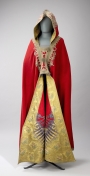
A burnous is a man’s hooded cloak traditionally worn in North Africa, especially Morocco. There is a particular example that is now in the Royal Collection, London (RCIN 61156). It is believed to have been owned by the French Emperor, Napoleon Bonaparte, and taken after he was defeated at the Battle of Waterloo (Belgium) on 18 June 1815.
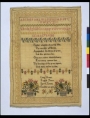
Missionary samplers are examples of embroidery that were made by girls outside of Europe in Christian mission schools, especially during the colonial era. Taken from a centuries-old European tradition and introduced to still ‘uncivilised’ parts of the world, needlework was regarded as a vital element of the social, moral and, above all, religious upbringing of girls.

Henry FitzRoy, Duke of Richmond and Somerset (1519-1536), was the illegitimate son of Henry VIII by Elizabeth Blount ('Bessie Blount'), a lady-in-waiting to Catherine of Aragon. The miniature was painted by the Flemish artist, Lucas Horenbout (c. 1490-1544). The water colour image was worked in c. 1533-1534.
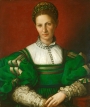
Portrait of a Lady in Green is a painting of an unknown woman by the Italian (Florentine) artist, Agnolo Bronzino (1503-1572). It has been suggested that the sitter is the daughter of the Florentine, Matteo Soffaroni, but this is not certain. The portrait is believed to have been painted between 1530 and 1532. It is now in the Royal Collection, London (acc. no. RCIN 405754).