

Shisha work is a type of applied decorative needlework that is characterised by small pieces of reflective material that are sewn onto a cloth ground material. This technique is also known as mirror embroidery. It is popular in many parts of Asia. The term derives from (Persian) shisheh for 'glass'. In parts of India this type of work is also known as Abhala Bharat (Hindi).
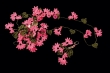
Oya is a Turkish word referring to various forms of narrow lace trimmings, made and worn throughout the eastern and southern parts of the Mediterranean region, as well as in parts of Armenia. It is particularly associated with Turkey. Oya is often used to decorate garments, especially women’s headscarves and household textiles, such as sheets, table cloths and towels. Modern oya is also used to create jewellery.

Macramé is a form of knotted lace that probably developed from the knotting of warp fringes on a woven material to prevent unravelling and to provide extra decoration. According to the Shorter Oxford English Dictionary, the word macramé comes from the Turkish word makrama, meaning a bedspread (also the Arabic word mikrama, with the same meaning). But the word might also originate in the Arabic migramah, meaning a fringe.

Knotted lace is a term that covers a group of laces created by various forms of knots. This group includes the lace trimmings that are traditionally made by women living along the eastern and southern sides of the Mediterranean, as well as in parts of Armenia. The Turkish term for this type of lace is oya (a generic term for several methods of making such lace trimmings).
Ground material is a general term for the base or foundation of a piece of decorative needlework.

A stitch sample is a piece or pieces of material on which one or more structural or decorative stitches are worked, usually in a random manner, and then fastened together in some manner (perhaps pinned or stitched together). Such samples are generally intended to remind the embroiderer of how to work the stitches and are used for private information and purposes.
More...
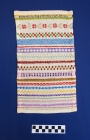
A stitch sampler is a form of sampler, in which two or more different decorative stitches are worked on the ground material in a pre-ordained order or pattern, in order to display the knowledge and skill of the embroiderer and/or his/her teacher.

A commemorative sampler is a type used to commemorate one or more birthdays, weddings, funerals or special events within a family or community. This type of sampler was popular in Northern Europe and elsewhere from the seventeenth century onwards and is still being produced.

A monogram is a design composed of one or more letters, typically the initials of a name (such as GVE), which are often used in order to identify the owner of an object or garment. A monogram sampler, therefore, is a form of sampler in which one or more sets of (decorative) initials are worked on a piece of ground material.

The qalansuwa is a black hood that covers the head and neck's back of a Coptic monk or nun in Egypt. It is associated with a monastic professional of the Coptic Orthodox Church of Alexandria. It is officially called a koulla (Coptic; but the word itself is wide-spread in the Middle East), but by the end of the twentieth century it was commonly referred to as a qalansuwa (Arabic).