
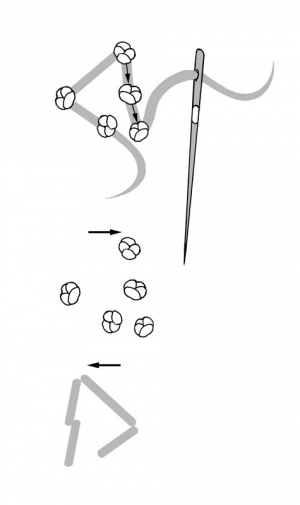
The French knot is a decorative stitch used to create one or more small knots or dots on a ground material.
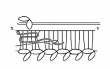
An overcast bar is a technique whereby a stitched bar is created between two woven areas of cloth. This is done after a section (or group) of the ground threads has been removed (as happens in drawn thread work and cutwork).

A buttonhole(d) bar is stitched between two areas of woven cloth, made after a section (or group) of the ground threads are removed (as happens in drawn thread work and cutwork).

The various types of glass beads currently available are made with one or more of the following finishes in order to give a wider variety of visual effects. Some of the most widely used forms are listed below:

Seed beads is a generic term for small, glass beads. However, it more specifically refers to a shaped spheroid bead ranging in size from under 1 mm to several mm. Seed beads are often used for embroidery as well as for bead weaving.

Bugle beads are thin, tube shaped beads that are longer than they are thick. Bugle beads are normally made out of cut lengths of glass cane. Bugle beads normally range from 4 to 30 mm in length. The bead holes are normally either round or square in shape. The square holes are usually slightly larger and serve as internal facets.

Nettle bast fibre is obtained from the stem of several different species of nettle plants of the family of the Urticaceae. There are many different types of nettle, especially those of the genus Urtica, that can be used for making a thread. Urtica dioica and Urtica urena, for example, were used in Europe for making ‘nettle cloth'. Ramie, another bast fibre, is also of the Urticaceae family, but from the genus Boehmeria.
More...


Tom Mor is a West Country (England) artist and cartoonist active from the late twentieth century. He designed several commemorative embroideries, such as the New World tapestry, the Plymouth tapestry and the Bristol Berkeley Plantation tapestry.

The Lennox point tresse is a small example of point tresse (hair lace) said to be made by Lady Margaret Douglas, Countess of Lennox (1515-1578) from her own hair. She was the mother of Henry Stuart, Lord Darnley, the second husband of Mary, Queen of Scots.
‘Wheels of cloth’ are long, narrow strips of handwoven cloth used to make Tuareg men and women’s clothing in Saharan Africa.