
Gretchen embroidery is a decorative needlework technique that combines couching and embroidery, and popular in the late nineteenth and early twentieth centuries in the USA.
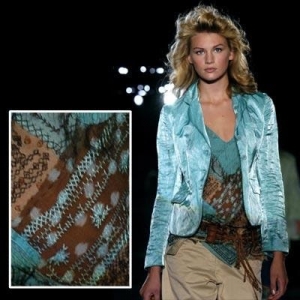
Siwa Creations is an Egyptian company, founded by Laila Neamatallah, working with hand embroiderers in the Siwa oasis, Egypt. Siwa Creations was set up in 2001 with the aim of helping Siwan women and girls develop and sell their embroideries.
A darning stitch is a decorative technique whereby a running stitch is worked in parallel lines in order to create a pattern with both negative and positive elements. The result is called darned embroidery, or pattern darning. It is normally a form of counted thread embroidery, worked on an even-weave ground.
Embroidery floss is the American term for stranded embroidery cotton threads. GVE

Stranded embroidery cotton threads are a form of mercerised yarn that became available from the late 1920's onwards. They are now widely used for various types of embroidery. Stranded cotton threads are very shiny and come in six strands that can easily be divided (Z-plied, s-spun). They were initially made by DMC, but were later copied by many other companies.

Perlé cotton is a form of mercerised cotton thread that became available from the 1920's onwards. Perlé is a non-divisible thread, usually Z-plied and s-spun. It is regarded as a strong thread with a lustre. Perlé (also known as pearl or French perlé) was initially made by DMC, but was later copied by other companies.

Various forms of mercerised cotton embroidery thread were developed in the late nineteenth and early twentieth centuries, which are still widely used. The most popular forms are perlé and stranded cotton yarns.
More...

A patchwork quilt is a traditional form of quilt, in which the decorative, top layer is made from some form of patchwork. Patchwork is where two or more pieces of cloth are abutting and sewn together. There are various types of patchwork used for making quilts, such as crazy and pieced. Many forms of quilts are in fact patchwork quilts.
In the USA, the term Honiton lace is often used to describe all types of tape (Renaissance) lace, while at the same time excluding ‘real’ Honiton (bobbin) lace.
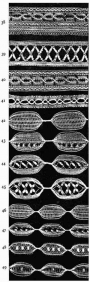
Honiton braid is a brand name for a form of machine made tape lace. From the mid-nineteenth century onwards, this type of tape was used in Britain for making Branscombe (tape) lace. Branscombe is a village ten miles south of Honiton, hence the name for the braid that was used for the lace.

Honiton lace is a type of appliqué net lace that uses bobbin lace slips that are applied to a net slip. It is named after a town in East Devon, England, that has been an important lace making centre since the seventeenth century.