

A negative design is an artistic device whereby the design is formed by filling in the background to that design, rather than the design itself. The use of negative designs can be seen, for example, in Assisi embroidery and some forms of Fes embroidery. Also known as void work.
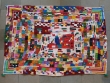
The Siddis of western India and southern Pakistan are descendants of early African immigrants and of enslaved Africans brought to western India by the Portuguese and other groups from the sixteenth century onwards.
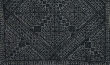
Fes style embroidery is a form of double running stitch decoration based on a form of embroidery from Fes, Morocco. It was introduced throughout Morocco by the French in order to revive Moroccan arts and crafts during the First World War (1914-1918).
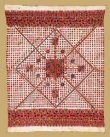
Meknes is a city in northern Morocco, some 130 km east of the capital Rabat and 60 km west of Fes. It is named after a Berber tribe called the Meknassis. The city appears to have been founded in the tenth century AD. In the seventeenth and early eighteenth centuries, Meknes was the capital of Morocco, before the centre of the country was relocated to Marrakesh.

The production of gold embroidery in Morocco is not unique to Fes, but the city is particularly famous for it. In the 1930's the work of gold thread embroiderers in Fes was documented by the French writer, Anne-Marie Goichon, and much of what she wrote in 1939 with respect to techniques still applies to the latter half of the twentieth century.

A needle threader is a small sewing tool designed to help pull a thread through the eye of a sewing needle. Both hand and machine forms exist, but the information given here refers to the hand sewing version.

Tambani is a South African self-help group that is making embroideries and appliqués based on local, Venda folklore. The Venda live in northeastern South Africa, in an arid area with little employment. The Tambani group grew out of the work of a South African academic, Ina le Rouz, who in 1989 carried out a research project about Venda folk tales at the University of Venda.

A feature of some Dutch and Belgian samplers is the presence in the design of either a spinning woman or a spinning monkey. The woman/monkey is usually shown spinning with a hand spindle and distaff, although later examples sometimes include a spinning wheel. The monkey is a reference to a medieval ‘joke’, in which a (mischievous) monkey represents a woman.
More...
Ksour es-Saf (Ksour Essef) lies close to El Djem in southern Tunisia. The town is known for its small head shawls (ta’jira). These shawls are traditionally embroidered by men.
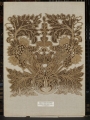
Stringwork was a popular form of decorative needlework in seventeenth and eighteenth century Europe. A thin, round cord was wound onto a large shuttle with open ends, then the cord was unreeled and knots made at intervals. The resulting knotted cord was fed into a bag, suspended either at the left wrist or from a belt. The knotted cord was then couched down in a decorative pattern onto an usually linen ground of some kind.
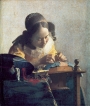
A lacemaker is a general term used to describe someone who makes hand or machine lace. With respect to the hand lace forms, the term is mostly used for someone who makes bobbin lace, rather than, for example, needle lace.