

A stiletto is a small pointed instrument with a long handle and blade, used in decorative needlework to make holes. The blade is round and tapering to a point. A stiletto pushes the ground warp and weft threads aside (rather than cutting them, as with a pair of scissors).
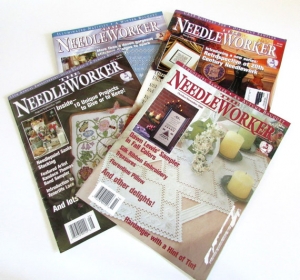
Needleworker is a term, used especially in North America, for anyone who makes (decorative) items with a needle. The term is also used to indicate anyone engaged in needlework, when opposed to embroidery. This definition/use of the word needleworker does not appear in either the English Oxford Dictionary (UK) or the Merriam-Webster Dictionary (USA).
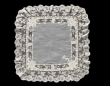
Whitework is a general term for a group of embroidery styles that are worked in a white thread on a white ground material. Some forms are sometimes classed as forms of embroidered lace.
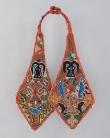
Beadwork, often also called beading, is the general term used to describe the craft of working with beads in some manner, in order to produce a decoration or decorative item. The beads may be worked in a variety of techniques, such as being strung together on a cord, thread or wire; sewn down onto a ground material; woven together on a loom (on-loom work) or stitched together in the hand (off-loom work) in some manner.
Beader is late twentieth century jargon for anyone who makes decorative items with beads.

A beading needle is a long, very fine tool with a long eye and normally a sharp point. It is used for working beads, cords, pearls, ribbons, sequins, etc. There are various types of beading needles, varying in size, construction and general appearance. English beading needles, for example, are normally slightly more flexible and longer than their Japanese equivalents.

Jet is a hard, compact black form of lignite (highly compressed, decayed wood), which is normally matt in appearance, but which can take a brilliant polish. The word derives from the Old and Middle English geet, jeet and later jeat. It is comparable to the Old French word geet, and later jaiet or jayet. The modern French work is jais.

Russia braid is a metal wire that can be used for metal thread embroidery and twists. It is a narrow braid with two cores laid side by side and bound together by a fine yarn (often a passing, or some other metal thread), laced in a figure of eight. In France it is known as soutache.

Examples of hand embroidery have been found at various archaeological excavations dating back to at least the second millennium BC, although the art of embroidery probably goes back much further. One of the oldest surviving groups of embroideries comes from the tomb of the famous Egyptian pharaoh, Tutankhamun (died c. 1323 BC).

Many people regard embroidery as a craft, rather than an ‘art’. Consequently, embroidery is not often discussed alongside established 'high art’ forms, such as painting or sculpture. Yet the degree of creativity, use of colour, subtle changes in design, emotional response to a particular setting or situation, all aspects attributed to ‘art’, can be found in embroidery.
More...

There are two basic approaches to cataloguing a type of embroidery stitch. The first is based on how the stitch is technically made. This form of cataloguing often divides the stitches into family groups, such as interlaced stitches, threaded stitches, whipped stitches.
Whipped stitches are a group of techniques in which there is a line of ‘foundation’ stitches and then a second thread that is ‘whipped’ over them vertically.

Interlaced stitches are a group of stitches in which there is a line of ‘foundation’ stitches and a second thread (sometimes a third one). The second thread is interlaced through the foundation stitches without entering the ground material. The second thread regularly returns on itself. This group is comparable to the threaded stitches, but the secondary threads of the latter group do not return on themselves.