

Bobbin lace, also known as pillow lace, is the product of a modified weaving process that takes its name from the way it is made, namely using a series of bobbins on a lacemaking pillow. The warp threads on a loom are represented by the threads that hang straight down, weighed by the ‘passive’ bobbins. The weft threads on the loom are represented by the ‘worker’ or ‘weaver’ bobbins that go over and under the passive bobbins, so creating a piece of woven cloth.
In general, the English term ‘darning’ refers to a sewing technique used for repairing holes or worn areas of a fabric. The term darning, however, can also refer to several decorative needlework techniques that use darning stitches (in this context the term used for running stitches or straight stitches). The main types of darning in this context are:
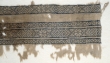
Darned embroidery, also known as pattern darning, is a form of decorative needlework that uses running stitches (known as darning stitches) that go backwards and forwards in horizontal rows to create positive and/or negative designs.

Bullion stitch is a decorative technique that is worked by twisting a thread around a sewing needle several times before inserting the needle into the cloth. Short bullion stitches are sometimes called bullion knots.

Madeira lace is a type of bobbin lace originally worked by nuns and their pupils on the island of Madeira. This type of bobbin lace was regarded as a coarse copy of Maltese, Mechlin and torchon lace forms.

Madeira embroidery (or Madeira work) is a type of fine whitework embroidery and cutwork lace, which is very similar to broderie anglaise. It may thus also be classed as a form of embroidered lace. This type of work was developed by Bella Phelps, who introduced this form of embroidery to Britain from the 1840's.
More...
Broderie anglaise is a form of open whitework embroidery. It is also classed as a form of cutwork lace. Depending on the pattern, broderie anglaise may also be classed as an embroidered lace. Broderie anglaise became popular in the latter half of the nineteenth century, especially for women's and children’s clothing.

Spun silk is a form of cheaper silk thread. Normally one or more silk filaments are reeled directly from a silk worm cocoon and then used either in the form of floss silk, whereby the (sometimes very long) filaments are not, or very slightly spun, or a number of silk filaments (often comparatively short) are spun in order to make a usable thread. A spun silk thread is normally much cheaper than the unspun (floss) version.

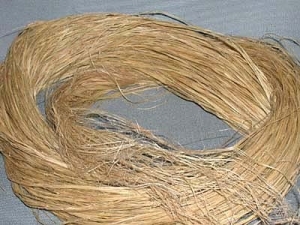
Tussah (or Tussar) silk is the principal type of wild silk. It often has a coarse, light brown colour. It is produced from cocoons of moths of the Saturniidae family, particularly the species Antheraea pernyi, a native of China. Not to be confused with tussah that is a plain weave fibre with a rib effect.

Wild silk is obtained from the cocoons of caterpillars living in a wild state or in semi-domesticity, mostly from the genus Antheraea, but also from others. See also Tussah silk.