
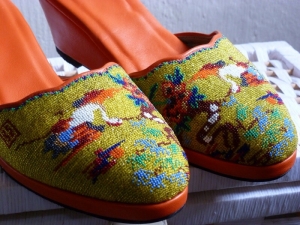
Kasut manek are slippers with beaded toe coverings, worn by Peranakan Chinese women, together with a batik sarong and a kebaya. The Peranakan Chinese are descendants of early overseas Chinese communities in Southeast Asia, including Malaysia, where they adopted various aspects of the indigenous cultures.
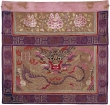
A tokwi is a decorative Buddhist altar frontal used by Peranakan Chinese in Indonesia and Malaysia. The Peranakan Chinese are descendants of early overseas Chinese communities in Southeast Asia, where they adopted various aspects of the indigenous cultures.
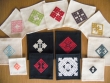
The kogin zashi technique is a form of darned embroidery from Japan. Kogin literally means ‘small cloth’ and zashi means ‘stitches.’ Kogin zashi is often classed as one of the sashiko forms, which was developed by the farmers of the Tsugaru district in the northern part of the Honshu Island, Japan. The patterns used for kogin zashi are stitched only on the upper area of kogin zashi clothes, using small, horizontal running stitches.
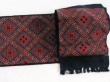
Kogin zashi is a form of darned embroidery from Japan. Kogin literally means ‘small cloth’ and zashi means ‘stitches.’ Kogin zashi, or more generally and simply called kogin, is often classed as one of the sashiko forms, and was developed by the farmers of the Tsugaru district in the northern part of the Honshu Island, Japan.
Zulu cloth is a nineteenth century English brand name for a closely woven cloth with a twill weave.

Zephyr yarn is an American brand name for Berlin wool or German wool, used from the nineteenth century onwards. The vivid colours and soft, light texture ('light as a breeze', hence the name zephyr) made the wool very popular in Europe and North America and aided in the popularity of Berlin wool work.
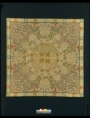
A table cloth is a textile of some form used to cover a table. Some cloths are designed to be spread on a table before placing the cutlery, glasses, food and so forth. Other cloths are ornamental in nature, with a secondary function of helping to protect the table from scratches and stains.

A tablecentre can be a piece of embroidery or decorated work, placed to decorate the centre of a table. It is sometimes placed over the table cloth.

A table runner is a narrow length of cloth that hangs over the table at two ends only. It can be made from decorative woven or embroidered cloth.
More...
Stitcher is originally an American term for a person who performs the last steps in finishing an item of clothing in a garment factory or atelier.

Sampler is a Middle English word that derives from the Old French essamplaire and eventually from the Latin word exemplum or ‘an example.’ The earliest English written reference to the word sampler, meaning a piece of embroidery serving as a specimen of the worker’s skill, dates to the early sixteenth century.