

English quilting is a technique whereby the whole article is padded and the design outlined in small running stitches, taken through three layers of material. It is important that each stitch is made in two separate movements, downwards and upwards and through all the layers of material.

Corded quilting (also known as Italian quilting) is a technique in which a double outline in small running stitches is worked through two layers of opaque material. This forms a narrow channel into which a cord or thick thread (usually either wool or cotton) is threaded from the back. This creates a series of lines in relief. This form of quilting can be found in many countries, not just Italy.
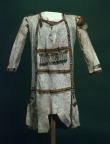
Canadian leather tunics are knee-length garments that were traditionally worn by native Americans in what is now the northern USA and Canada. The tunics are sometimes referred to as shirts, but technically they are tunics, as they are not open down the front.
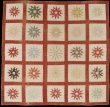
A block, in quilting, is the basic unit used to create a decorative quilt top. Blocks are usually square, but diamonds, hexagons, octagons, etc. are also used. Blocks are sewn together to make pre-determined (larger) patterns using patchwork techniques. Many blocks are also known by specific names, such as 'log cabin' (or 'loghouse'), 'pinwheel' or 'star'.
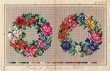
Berlin wool work charts are pre-printed charts with a wide range of designs, which were initially made in the first half of the nineteenth century in Berlin (hence their name) and later copied by printers in many countries. This type of chart was used for Berlin wool work, a form of canvas embroidery that was popular in many countries in the nineteenth century.
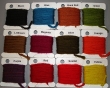
Berlin wool is a type of wool fibre derived from Merino sheep in Saxony, Germany. In the nineteenth century, the wool was sent to the city of Gotha to be combed (worsted), spun and then taken to Berlin where it was dyed and sold. The wool was softer and separated more easily into strands than types of wool from England and the Netherlands, which were widely used at the time.

"Bearing Witness: Embroidery as history in post-apartheid South Africa," was an exhibition held at the Fowler Museum, University of California, Los Angeles (USA), between 7th September – 7th December 2014. The exhibition was organised by Gemma Rodrigues, Curator of African Arts, Fowler Museum.

A bead is a small object that is pierced for threading, stringing or weaving. Beads can be made of any material, the most common being glass, metal, plastic, seeds, stone or wood. Beads come in a wide variety of shapes and sizes.

Batik is an Indonesian term widely used to denote a method of cloth decoration that uses a resist dyed technique. Batik designs are created by applying molten wax, or sometimes a rice paste, onto the ground cloth and then dyeing it in a cold dye bath. The areas of cloth covered by the wax remain undyed.

More...

Ainu decorative needlework is associated with the indigenous people of northern Japan and parts of northeastern Russia (Sakhalin and Kuril Islands). By the twenty-first century the Japanese Ainu were mainly concentrated in the Hokkaido region.


Twist (French: torsade) is a form of metal thread made up of two or more strands twisted together, and used as applied decoration. The twist is normally couched down with a thread of the same colour. The stitches are sewn at the same angle as that of the twist itself, so that the stitches are invisible.

Lizerine is a form of metal thread made from tightly coiled wires, which looks like a strand of gold pearls. Lizerine, also called lizardine, has a flatter, more solid coil in comparison to pearl purl and jaceron purl, which are rounder. Lizerine and jaceron purl are sometimes classed as pearl purl.