

Nålebinding is a looping technique used to produce a textile with a nålebinding needle and a thread. The technique involves passing the full length of the thread through each loop using a flat needle. The lengths of thread are pieced together during the working process. There are different ways of working the loops.
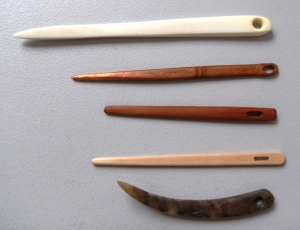
A nålbindning needle is a bodkin-like needle used to make a complicated, looped material called nålbindning. A nålbindning needle is normally flat, between 5 and 10 cm in length, with a rounded eye at one end. The other end is normally slightly pointed, but blunt.
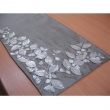
Nacré work is a form of decorative needlework using mother-of-pearl (French: nacré). Traditionally, nacré work consists of shapes, such as petals and leaves, cut out of mother-of-pearl, which have one or more holes drilled into them. The shapes are then sewn onto a velvet or silk ground using silk or gold thread.
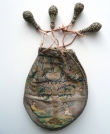
The concept of the Maundy Money Purse relates to a tradition in England, in which the reigning monarch gives special, so-called Maundy coins to elderly people. The tradition dates back to the fifteenth century. Royal Maundy is a Church of England religious service held on Maundy Thursday, the day before Good Friday, as part of the Easter services that culminate in the Easter Sunday service a few days later.

Khawlan lies between Amran and Hajja, to the northwest of Sana`a, the capital of Yemen. Local women wear a daily and a festive version of an embroidered dress. Until the 1960's, both the daily dress and the festive examples had broad sleeves and were made from indigo dyed cotton cloth. By the end of the twentieth century, the sleeves on festive dresses had become much narrower and were often made of dark blue or black cotton material.
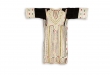
The Jebel Sabir region just south of Ta'izz, in southwestern Yemen, is known for its heavily embroidered festive dresses worked predominantly in white cotton. Those worn for special occasions, notably weddings, tend to be narrow with wide sleeves. The neck opening is wide and rounded. The embroidery is normally concentrated on the sleeves, around the neck opening, at the front panel and around the whole of the skirt section.

The Jebel Haraz region of Yemen is known for its indigo dyed dresses with applied and embroidered decoration. Jebel Haraz is a mountainous area that lies between the Tihamah coastal plain and Sana’a, the capital of Yemen.

The Imperial Mantle is a large, semi-circular mantle or cloak worn by the sovereign during the British coronation ceremony. The Imperial Mantle is also known as the Pallium or the Dalmatic Robe. The design is based on earlier mantles and has its origins in a priestly garment (cope). Its form has not changed much since the medieval period.

The Great Exhibition of London in 1851 was the first in a series of international exhibitions in Europe and America. These exhibitions often showed a wide range of hand and machine made decorative needlework from around the world. The 1851 exhibition took place at the Crystal Palace, in Hyde Park, London. It was presented under the name of the Great Exhibition of the Works of Industry of All Nations.
More...

The Glove Collection Trust forms part of the Worshipful Company of Glovers of London. The Trust owns a large collection of historical and modern gloves dating from the seventeenth century onwards. Many of these items are decorated with embroidery and various forms of lace, especially the earlier examples.
A former is a term used in straw work. It is a template (flat or round, like a button) around which a length of damp straw (either whole or a strip) is wrapped.
![State portrait of Queen Elizabeth II wearing the coronation dress and purple Robe of Estate (portrait by Sir Herbert James Gunn [1893-1964];](/trc-needles/media/k2/items/cache/f2a45d40bd4cedd88506560045ec91e2_XS.jpg)
The coronation dress of Queen Elizabeth II of Britain (1953) was worn by the Queen at her coronation in Westminster Abbey, London. The garment was designed by the royal couturier Sir Norman Hartnell. The dress is made of white satin and embroidered with gold and silver thread and pastel-coloured silks. It is further decorated with seed pearls and crystals, which create a glittering lattice-work effect.

During their coronation, British monarchs are dressed in a series of specific garments. The order in which the garments are worn during the ceremonies is based on the Liber Regalis, a fourteenth-century illuminated manuscript. The appearance of the garments has changed little since the seventeenth century. The following description of the garments is based on the investiture of Queen Elizabeth II in 1953.