
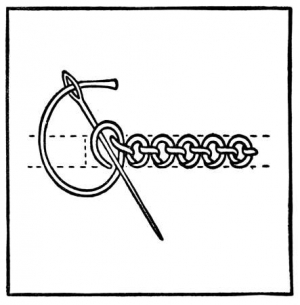
A link stitch is a composite stitch used to create a decorative line. It consists of chain stitches that are worked as a knot, and linked to the next chain stitch with a simple straight stitch. The link stitch is also known as a knotted chain stitch.
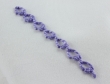
The knotted cable stitch is a composite stitch, which combines a chain stitch with a coral stitch, in a straight line or in a curve. It is also known as the knotted cable chain stitch.

A trailing stitch is a composite stitch generally used to make a raised outline. First a line of back stitches are made, and these are then whipped by another thread that is passed around the back stitches, without piercing the ground material. Also known as whipped back stitch.
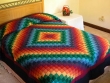
'Trip round the World' is the nme used for arranging the blocks of patchwork or quilting in such a way that the colours radiate from the centre. The pattern is particularly popular with Amish quilts. It is also known as 'Sunshine and Shadow'.
A half buttonhole is a stitch that is often used in utility quilting. It is worked as one 'leg' of the buttonhole stitch, creating a line of L-shaped stitches.
More...
Utility quilting is the general term for quilts made quickly, with large stitches of different sizes. Another appropriate name is quick stitch quilting. WV

The velvet stitch creates a pile effect on the surface of the fabric. Loops are made along horizontal lines, working from left to right, and from the bottom upwards. When completed the loops are cut and trimmed.

Water soluble stabiliser is the term used for any substance that is used to keep the ground material firm while embroidering. As soon as the work is completed, the stabiliser can be removed with (warm) water.

A water-erasable marker is used for embroidery, quilting, etc., when a pre-drawn motif is required. The lines can be removed with (warm) water when the work is completed.