

Acupictor (pl. acupictores) is a medieval Latin term for embroiderer. The Latin word literally means ‘painter with a needle'. This term should not be confused with ‘ACU pictures’ – this term stands for Army Combat Uniforms and refers to USA army uniforms (this term appears when googling).
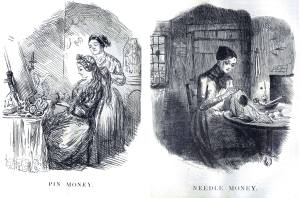
Pin money is an English term that refers, at the beginning of the twenty-first century, to a small or insignificant sum of money (‘spending money’), to be used for trivial purchases. It formerly referred to money a husband or guardian gave to a woman annually for her personal (dress) expenses (Shorter Oxford English Dictionary).

Pearl embroidery is a form of decorative needlework that uses applied, natural or cultivated pearls of various sizes. The pearls are normally pierced. It was a popular technique in the European medieval and renaissance periods for the embellishment of elite and religious garments.

Sometimes also known as the Overlord Tapestry, the Overlord Embroidery is a series of embroidered panels commemorating the Allied D-Day invasion of France in June 1944. Lord Dulverton of Batsford (Frederick Wills, 1915-1992), inspired by the Bayeux tapestry, commissioned the embroidery in 1968. Sandra Lawrence created the design.

The Murray and Roberts tapestries are a series of commissioned embroideries depicting South African trees. The plans for the tapestries were developed in 2007, when the construction, contracting and mining company of Murray & Roberts was building a new head office in Johannesburg, South Africa.

John Mercer was an English dye chemist and cloth printer. Born in Great Harwood, Lancashire, in 1791, in 1844 he developed a process for treating cotton that came to be named after him, mercerisation. With this process the cotton fibres pass through a sodium hydroxide (caustic soda) bath, which causes the fibres to swell and makes them stronger and easier to dye. The process was perfected by Horace Arthur Lowe.

The Japanese stitch is an embroidery technique that consists of a horizontal satin stitch worked along diagonal lines. It is associated with Japanese screens.

Bokhara couching is the use of a particular embroidery stitch, in which the same thread is used both for the laid and the tying down stitches. The couching thread is carried across the space from left to right and then fastened down by the needle on its return journey with slanting stitches at regular intervals. These stitches are often used to form a series of pattern lines across the area being decorated.

Beetlewing embroidery is an applied technique using iridescent beetlewing casings (rather than the actual beetlewings). For at least several centuries, this type of work has been carried out in various Asian countries, notably China, India, Japan, Myanmar and Thailand.

Sewing pins were expensive items in the early USA and were generally imported from Britain. During the War of 1812 (1812-1815) between the USA and Great Britain, there was an embargo on imports from Britain, so pins became even scarcer. An entrepreneur is said to have taught convicts at the Greenwich Village State Prison in New York City how to make pins by hand, which he then sold until the end of the war.