

The basic structure of a pompom (also known as pompon, from French pompon) is made by winding a length of thread around a card template, removing the looped threads from the card, and then binding them tightly around the middle. The looped ends on both sides are subsequently cut through and then manipulated into the desired shape.
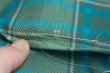
A blind herringbone stitch is a technique whereby the herringbone stitches, which are used for hemming, are worked under part of the hem itself. This is done by rolling back part of the hem, stitching the hem in place, and then folding back the flap into situ, in this way hiding the line of stitches. See also the blind hemming stitch.

A blind hemming stitch is a technique whereby the hemming stitches are worked under part of the hem itself. This is done by rolling back part of the hem, stitching the hem in place, and then folding back the flap into situ, in this way hiding the line of stitches. See also the blind herringbone stitch.

The Berwick stitch is a form of blanket stitch, whereby a tight knot is made at the lower edge of the stitch, in order to firmly fix the stitch in place. The first time the name of Berwick stitch was used was in Anne Butler (Anne Morrell), The Batford Encyclopaedia of Embroidery Stitches (1983). The stitch was named by the author after the street in Manchester, where she was living at the time.

Basketweave is the general term for a structure that occurs in many forms of textile production and decoration. It is characterised by the interlocking of a number of horizontal and vertical strands, making a square pattern that has the appearance of the structure of woven baskets. See also the basketweave stitch.

A basque stitch is made with a reversed S-shaped loop, which is caught at the bottom with a small stitch. The needle is then brought back to the top of the loop in preparation of the next stitch. This stitch allegedly derives from the Basque region of northern Spain and southwestern France and was originally worked with a red thread over a green ground material, or with a white thread on a blue-green fabric.
More...

Armenian edging is a decorative technique for a hemmed edge, worked from left to right, with small stitches.