

The Victoria and Albert Museum in London houses an embroidered picture that shows a scene from the classical story of Tomyris, Queen of the Massagetae, namely the moment that she receives the head of Cyrus, the king of the Persians. The embroidery is worked on cream satin and carried out with various forms of metal thread and with many shades and colours of silk thread. There is also some shading with water colour.

The Victoria and Albert Museum in London houses an embroidered picture, the design of which was taken from an illustration in Aladdin, by Walter Crane (1845-1915). It is worked on linen with silk threads. It measures 79 x 65 cm. Aladdin, or, The Wonderful Lamp, was published in 1874 (Routledge, London). It is a children's story taken from Thousand and One Nights, with illustrations made by Walter Crane.
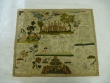
The Victoria and Albert Museum in London houses an incomplete embroidered picture from England, which dates to about AD 1660. It shows various scenes from the Biblical story of Abraham and Hagar. It is worked on silk satin with silk and metal threads. Ink (for the drawings, still clearly visible) and mica have also been used. It measures 47 x 56 cm.
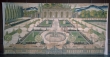
The Victoria and Albert Museum in London houses a large hanging with a representation of the gardens of Stoke Edith, Herefordshire, England. The hanging was made in England between c. 1710 and 1720. The embroidered picture was worked on linen with silk and wool thread (mainly tent stitch), and applique (the Chinese porcelain pots with fruit trees, worked with chain stitch).
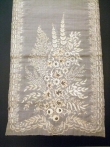
The Victoria and Albert Museum in London houses a scarf made of piña (pineapple) cloth with cotton thread embroidery. The embroidery includes flower and leaf motifs. The shawl measures 285 x 44 cm. The scarf was embroidered in the Madras area around 1855. The scarf was part of the India Museum collection in London until 1879 when it was transferred to the South Kensington Museum (now the Victoria and Albert Museum).
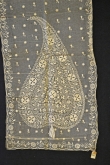
The Victoria and Albert Museum in London houses a scarf made of cotton net with silk thread embroidery. The scarf originates in the Madras area and dates to c. 1855. It fomed part of the collection of the India Museum in London, before it was transferred to the South Kensington Museum (now the Victoria and Albert Museum) in 1879. The embroidery shows two large buteh motifs at each end. The shawl measures 126 x 54 cm.
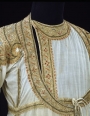
The Victoria and Albert Museum in London houses a young man's (formal) gown, or angarkha, from Lahore, South Asia, and dating to the mid-nineteenth century. The gold and silk thread embroidery has been applied separately to the cotton ground material of the gown.

The Victoria and Albert Museum in London houses a sandalwood box that is decorated with porcupine quills. The box dates to about AD 1855 and was made in Vizagapatam, along the east coast of India. It also includes pieces of buffalo horn and ivory. The box is 23.5 cm high, 33.5 cm wide, and 24 cm deep. The box was apparently made for a Western market, and in particular for the Exposition Universelle in Paris, in 1855.

In April 2015, Bonhams in London auctioned a collection of armoury originally taken from the fortress of Seringapatam (Srirangapatna), the last refuge of Tipu Sultan of Mysore, after the British-Indian army had taken the site in AD 1799.

In April 2015, Bonhams in London auctioned a collection of armoury originally taken from the fortress of Seringapatam (Srirangapatna), the last refuge of Tipu Sultan of Mysore, after the British-Indian army had taken the site in AD 1799.
More...

The Victoria and Albert Museum in London houses a saddle cloth from the Deccan in India, which is believed to have belonged to Tipu Sultan of Mysore, who was defeated by the British in AD 1799 at the Battle of Seringapatam (Srirangapatna). The saddle cloth is 143.5 cm high and 142.2 cm wide. It is made of a velvet ground material embroidered with silver gilt thread, with wire and with sequins.

The Victoria and Albert Museum in London houses a decorated huqqa mat (a mat on which a water pipe was placed) from India, perhaps from Delhi, and dating to about the third quarter of the nineteenth century.
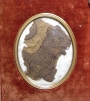
Worchester Cathedral in England owns some medieval embroidery fragments, including a fragment from the burial shroud of King John (1166-1216), made of Chinese silk with a geometric design and decorated with gold thread embroidery in underside couching. It was removed from King John's tomb in the Cathedral in 1797. The embroidery depicts an animal (a leopard?). The outline of the animal is highlighted with chain stitch.

The Los Angeles County Museum of Art is a complex of buildings along Wilshire Boulevard in Los Angeles, California. It was established in 1910 as part of the Museum of Science, History and Art in the park of the University of Southern California. The current museum houses some 150,000 objects, dating from prehistory to the present-day.