
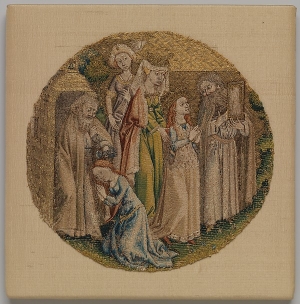
'The Hermit Adrian Shows St. Catherine an Image of Christ and Baptizes Her' is an embroidered picture in the shape of a roundel, which originally may have been attached to a larger textile, as for instance an altar frontal or ecclesiastical vestment. It was made in the (southern) Netherlands around AD 1430, in the or nué technique, with silk and metal thread on linen. It measures 16.8 cm in diameter.
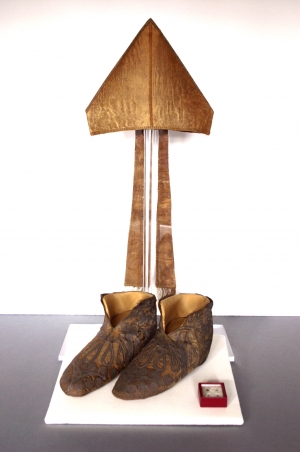
The medieval tomb of Archbishop Hubert Walter in Canterbury Cathedral was opened in 1890. The tomb contained silver items and the remains of the garments in which the Archbishop had been buried. Hubert Walter was an important royal advisor in the time of Richard I (1157-1199) and his succesor, John (1166-1216). He accompanied Richard on the Third Crusade.

The Geneva Bible now in the Bodleian Library, Oxford, was presented on New Year's Day 1584 to Queen Elizabeth I by the printer, Christopher Barker (c. 1529-1599). The cover is decorated with gold, silver and silk threads with seed pearls on a velvet ground material. The motifs include a symmetrical arrangement of stems worked in gold, with roses in Tudor style.
Practical Hints on the Revived Art of Crewel and Silk Embroidery, by Mary Anne Turner, was published in London in 1877.
The Sens Museum, Treasure and Palais Synodal (the Sens Museums / Musées de Sens) are housed in the former Archbishop's Palace of Sens, France. It includes the cathedral treasure, which is one of the richest in France and houses costly textiles and religious vestments, ivory objects and silverware.
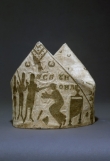
The Bayerisches Nationalmuseum (Munich, Germany; acc. no. T 17) houses a mitre (17.3 cm high) from England, which dates to about AD 1200. It bears representations of the Stoning of St. Stephen (reverse) and of the Murder of Thomas Becket (obverse). It is made of white silk, probably from the Middle East or Byzantium.

The Vatican Museum houses a cope that was made in England in the late thirteenth century in the tradition of opus anglicanum. It has a red silk ground material, and is embroidered with gold and silver-gilt threads and silk. It measures 137.2 x 309.9 cm. Originally it was larger; it has been trimmed along the semi-circular edge. It is kept in the Biblioteca Apostolica Vaticano, Museo Sacro, acc. no. 2447.
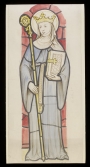
St. Etheldreda (Æthelthryth; St. Audrey) founded the double monastery of Ely in 672. She was the daughter of the East Anglian King Anna, and later became the Queen of Northumbria. She is recorded to have granted a fine stole and maniple, embroidered by herself with gold and precious stones, to St. Cuthbert, the contemporary young prior of Lindisfarne. Her feast day is 23 June, the date of her death.

A Schole-House for the Needle is a pattern book published in 1624 by Richard Shorleyker. It includes patterns for needlework, especially embroidery and needle lace.

Mary Knowles, née Morris (1733-1807) was a Quaker, a gifted speaker and religious activist, especially in the struggle against slavery. She was also an accomplished craftswoman creating embroidered pictures. She was particularly known for a needlework representation of King George III, after a painting by Johan Zoffany (1733-1810), which he made in 1771.
More...
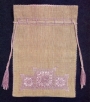
The Langdale Linen Industry was set up in Westmorland, Cumbria, by Alfred Fleming, with the support and patronage of William Ruskin (1819-1900) and upon earlier work carried out by Miss Susanne Beever (1805-1893), who came from the area and who was the editor of Ruskin's book, Modern Painters. The Industry was initally led by Fleming's housekeeper, Marian Twelves.

Sarah Bland (1810-1905) was listed as a 'gentlewoman' in the British 1851 census, and she is not listed as having an occupation in succeeding censuses. She is however known for her many designs, of a very high quality, that she copied or designed for embroidery, and which she collected into an album. Many of the designs are now held in the Victoria and Albert Museum, London.
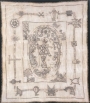
The Victoria and Albert Museum in London houses a remarkable example of blackwork, the use of which remains a moot point. It may have been a wall hanging, a cupboard cover or a table cover. It was made in England and dates to the late sixteenth century. It measures 114 x 98.3 cm. It is embroidered in black silk on a linen ground. There is also couched cord and a bobbin lace border.
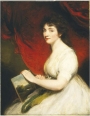
Mary Linwood was a renowned embroideress who specialised in the technique of needlepainting, whereby oil paintings and other illustrations are exactly copied in embroidery against a painted background. She was born in Birmingham, and by 1776 she was exhibiting her work to the Society of Artists in London.