
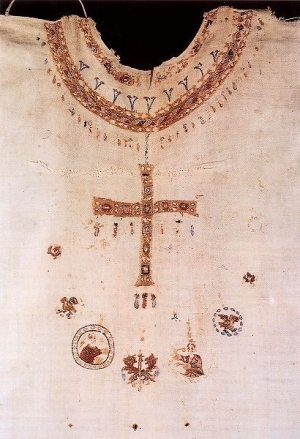
The so-called 'Chemise of St Balthild' is preserved at the Musée Alfred Bonno, Chelles (Seine et Marne, near Paris), in France. It dates to the mid-first millennium AD and is attributed to an Anglo-Saxon slave girl who became the wife of the Frankish king, Clovis II. Balthild of Ascania died c. 680 in a convent that she had founded at Chelles (the later Abbaye de Notre Dames des Chelles).
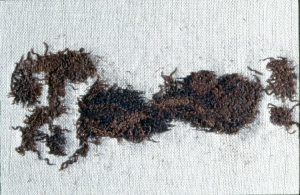
A woman's grave excavated 1863-1864 at Kempston, Bedforshire, UK, contained a relic box (Box. No. 141) that yielded a fragment of purple, woollen embroidery, dated to the seventh century AD. It has been classed as the earliest extant piece of Anglo-Saxon embroidery. The same grave also contained the so-called Kempston Beaker.

Hedeby, or Haithabu in German, is a site located in Schleswig-Holstein, in the extreme north of Germany, along the Danish border. In the Viking age it was an important maritime centre. Excavations at the site started in 1900. Finds from the site are exhibited in the Wikinger Museum Haithabu. The site yielded many fragments of textiles, but no clear evidence of decorative needlework.
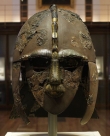
Sutton Hoo, in East Anglia, England, is the site of two sixth and seventh century burial places, one of which contained an undisturbed ship burial, which was excavated in 1939. The burial chamber in the ship included many textile fragments, possibly from blankets, cloaks or hangings. The hem of a pillow cover was decorated with a strip reminiscent of the decoration of the woollen cushion from Mammen in Denmark.

Valsgärde is the name of a farm just north of Gammla Uppsala, the ancient centre of the Swedish kings. The place is famous for its burial site, with graves dating from the sixth (the earliest ship burial) until the eleventh centuries. The site was excavated between 1928 and 1952, and its finds have been compared to other ship burials, including that of Sutton Hoo.

Excavations into Viking-period levels at York, northern England, yielded only one example of embroidery. It was found on a small bag that dates to the late tenth or early eleventh century. The bag has an outercover of red silk samite, perhaps imported from Byzantium. It is decorated with a crude silk cross, in what appears to be chain stitch or stem stitch.

Birka is an archaeological site in Sweden, located on the island of Bjørkø, some 30 km west of Stockholm. It was an important maritime centre during the Viking age. It has been an UNESCO World Heritage site since 1993.

The Oseberg ship burial is located near Tønsberg in the district of Vestfold, Norway. It was excavated in 1904-1905. The burial has been dated to AD 834. The excavated ship and many of the burial goods are on display in the Viking Ship Museum at Bygdøy just west of Oslo.

Embroidery seems to be a relatively late development in Scandinavia. Textiles were generally adorned by other means, as for instance using different types of fibres for the fabric (wool/linen). 'Real' embroidery is known from the ninth century onwards.

The Mammen embroideries were discovered in 1868 at the mound of Bjerringhøj, near the village of Mammen, near Viborg, Denmark. The site has become particularly famous for the discovery of the so-called 'Mammen axe'.The embroideries and other finds were discovered in a chamber-grave of a man who was buried in the winter of AD 970-971.
More...
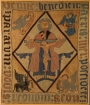
The National Museum Twenthe (The Netherlands) houses a late sixteenth century antependium that is embroidered with representations of the Throne of Mercy (or Throne of Grace) and the symbols of the four evangelists. The antependium is a good example of traditional Icelandic embroidery.

The National Museum of Iceland in Reykjavik houses an antependium that dates to the fifteenth or sixteenth centuries. It is embroidered with laidwork and couching (locally known as refilsaumur). The ground material is linen, most of the embroidery threads are of wool; some gilt thread was used to outline certain outlines. Almost all of the antependdium is covered with embroidery.
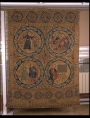
The Victoria and Albert Museum in London houses a bed cover from Iceland, dating to c. 1700. Its purchase was recommended by William Morris, the nineteenth century British supporter and promotor of the Arts and Crafts Movement. He regarded this cover as a reflection of Byzantine art (although perhaps more reminiscent of Sassanian art from Iran). The cover was made by the embroideress, Thorbjorg Magusdottir (1667 - 1737).

In the Ottoman world, the paçalık was the name of the embroidered dress worn by the bride the day after her wedding. It was also the name for a piece of embroidered cloth (always worked in a pair), sewn onto the legs of a woman's underpants.