
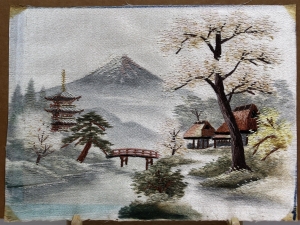
The tradition of making embroidered paintings developed in Japan in the nineteenth century. The representations made by famous painter/artists, such as Kishi Kikudō (1826-1897), Imao Keinen (1845-1924), and Takeuchi Seihō (1864-1942), were turned into embroideries, using the embroidery skills developed since the Edo period.
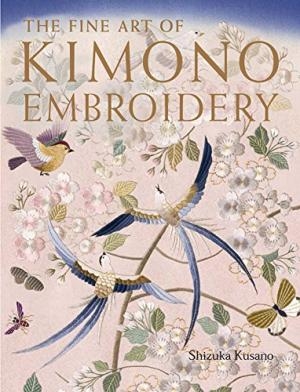
Shizuka Kusano is one of the most admired textile artists in Japan. She works particularly on the decoration of kimono, obi (sashes) and tapestries. She has been teaching at various institutes, and partook in more than thirty exhibitions. One of her most important books is The Fine Art of Kimono Embroidery (New York: Kodansha America, 2006, reprint 2012).
Niku-ire-nui is a Japanese embroidery technique that creates a raised look by the use of a cotton padding. Generally called the padded satin stitch.
Kiri-osae-nui (lit. cut-and-anchor stitch') is a laid work technique, in which a larger thread is fixed to the ground material by a series of small diagonal stitches.
Suga-nui is the Japanese term for the horizontal satin stitch. This technique is regarded as being part of the Kyo-nui ('Kyoto embroidery') tradition. WV
Nui-kiri is the Japanese term for a free-style embroidery technique that is being used for smaller designs, such as petals or leaves.
The wari-tsuke-mon'yo-nui ('allocated pattern stitch') is the Japanese term for an embroidery technique that gives an overall design more complexity.
Wari-nui is the Japanese term for an embroidery technique used to make bird's feathers, leaves or petals. The technique is generally known as the split stitch.
Keshi-nui is the Japanese term for an embroidery technique that creates work small dots, as for instance for a family crest. WV
Matsuri-nui is the Japanese term for a common embroidery technique to express lines.
More...
Koma-nui is the Japanese term for a form of couching, whereby the couching metal (gold or sliver) thread is fixed to the ground material with thin silk thread.
Tome-nui is the Japanese term used for the couching stitch that fixes the couching thread to the ground material. The term is particularly used for watashi-nui. WV
Hira-nui is the Japanese term for the satin stitch. It is generally applied to create flowers and leaves using a floss silk. WV
Sagara-nui (or sagura-nui) is the Japanese term for a form of French knot. This technique is regarded as being part of the Kyo-nui ('Kyoto embroidery') tradition. WV