
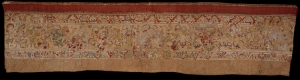
The Victoria and Albert Museum in London houses a cotton temple panel from Nepal, dated to the fifteenth and sixteenth centuries, embroidered with silk, using brick, satin and chain stitch. The embroidery illustrates a mythological scene.

The India Museum in London used to house part of a cotton scarf that was produced in Bengal and acquired in Nepal in c. 1855. It is decorated with a woven checked pattern with tussah silk threads. It is also embroidered in tussah silk with circular and floral motifs. The scarf has been in the Victoria and Albert Museum, London, since 1879. The piece measures 105 x 84 cm.
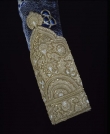
The Victoria and Albert Museum in London houses a remarkable woman's jacket from Nepal, dating to the mid-nineteenth century. It seems inspired by contemporary European/British military uniforms. The velvet garment has large cuffs, epaulettes and the front panels are densely embroidered with seed pearls, sequins and gold thread.
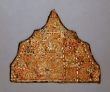
A temple banner from Nepal. dated to the fifteenth century, is housed in the collection of the Victoria and Albert Museum, London. The banner measures 40,5 x 32 cm. The cotton banner is embroidered with silk thread and shows Vishnu and his consort, Lakhshmi, positioned on the eagle, Garuda.
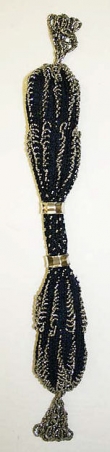
A miser's purge is a long and almost stocking-like tube of cloth, closed at both ends, with an opening in the middle, and squeezed through two (gold or silver coloured) rings (called the sliders), which were used to keep the coins in place and separate them.
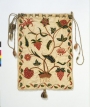
In eighteenth and nineteenth century England, ladies often carried a work bag that contained the basic tools and materials for fancy-work (more precisely known as fancy needlework), often including a housewife.
Knotting is an old technique, especially popular among ladies of leisure in the seventeenth and eighteenth centuries. The term is synonymous with stringwork.
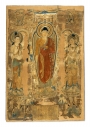
The collection of the British Museum, London, includes an embroidery from Dunhuang, Gansu province, China, that depicts 'Sakyamuni preaching on the Vulture Peak' and dates to about the eighth century AD. The panel measures 241 x 159 cm. It is worked in split stitch being passed through the plain silk weave and the hemp backing.
More...
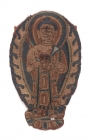
The British Museum in London houses a textile fragment with the embroidered figure of a Buddha standing on a lotus pedestal. The fragment dates to the eighth or ninth century AD, and was recovered between 1906-1908 by Sir Aurel Stein at Dunhuang, in Gansu Province, China. The fragment measures 10.9 x 6.2 cm.
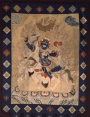
The collection of the Victoria and Albert Museum in London includes an embroidered thangka that probably derives from Inner Mongolia and dates to the period c. 1780-1850. The thangka has a silk ground material and embroidery worked with silk thread. There are some traces of painting.

The Rijksmuseum Amsterdam houses a small Ottoman purse (20 x 9 cm) that appears to have belonged, according to a letter that was inside the purse, to the grand vizier [Kara Mustafa] of the Ottoman Empire during the siege of Vienna in 1683. The purse is made of red satin and decorated with floral motifs embroidered with gold and silver thread.
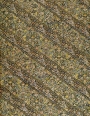
Naqsh work is one of the most famous and striking forms of Iranian embroidery, and was popular in the late eighteenth and nineteenth centuries. It is characterised by its diagonal bands and patterns of very densely worked stitching. The embroidery was especially used for panels that were sewn onto garments, in particular the lower legs of women's voluminous trousers.