

A reticule (knicknamed a ridicule in France) is the name for a small, woman's handbag, popular at the very end of the eighteenth and in the early nineteenth centuries, and Britain especially linked to the Regency period in England. The bags were mostly made of silk, and after about 1810 also of velvet. They could also be made of knitted fabrics.

'Treasures from the Cope Chest' was the title of an exhibition at Lancaster Cathedral (29 June -17 July 2011), which had the subtitle 'An Exhibition of Liturgical Vestments Past and Present'. The exhibition included a wide range of ecclesiastical garments worn by catholic clergy throughout the centuries.
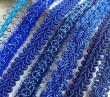
A trim is a decorative or plain band of some kind that is fastened in some manner along one or more edges of an object. Sometimes a trim is also used to decorate the main part of the object. The aim is to produce a contrasting effect, such as a fur trim on a leather ground, or an orange band on a blue ground material, etc. A braid, cord, ribbon or tape may be used as a trim.
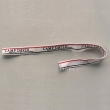
Tape is a term used for a narrow, flat and flexible woven band that is normally monochrome in appearance and usually between 0.5 and 2.5 cm in width. Tapes are often used to finish an edge (sometimes on the inside), or as a couched line in some forms of applied decoration, such as passementerie.
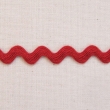
Rik-rak is a term for a narrow, flat and semi-flexible band that is deliberately woven into a zig-zag. They are normally, but not inevitably, monochrome in appearance. Rik-rak is usually between 0.5 and 1.5 cm in width. This form of band was developed in the late nineteenth century, initially to finish seams and hems and later as a form of decoration, especially on garments.

Lace, also known as military lace or navy lace, is a term sometimes used for a flat, semi-flexible, decorative woven band that has a metallic thread weft. Such bands are usually between 0.5 - 8.0 cm in width. This form of lace should not be confused with other forms of lace, such as bobbin lace and needlelace.

Cord is the term for a narrow, flexible woven band that is normally round or square in cross-section and monochrome in appearance, although multi-coloured cords also occur. Cords are usually between 0.25 and 1.0 cm in diameter. They are often used as a couched line in some forms of applied decoration, such as passementerie.

Bias binding is the term for a narrow, flat and flexible woven band that is cut on the bias to add flexibility. Bias bindings are normally monochrome in appearance, but multi-coloured and highly decorated examples also occur.

One thing that has become clear while writing TRC Needles and working on the TRC Collection database is the need for a consistent definition of various groups of objects. This problem applies especially to braids, cords and ribbons. Standard encyclopaedia and dictionary definitions are often too general or even contradictory, and the problem is compounded by different English UK and USA forms.
More...

Sometimes described as one of the most penetrating portraits painted by the Dutch, and Leiden-born master, Rembrandt van Rijn (1606-1669), the painting of Agatha Bas (1611-1659) now forms part of the Royal Collection in Great Britain (RCIN 405352) and is currently on display in Buckingham Palace.

The jupon (or surcoat) of the Black Prince (Edward of Woodstock, 1330-1376; the eldest son of King Edward III of England and the victorious English leader at Crécy and Poitiers in the Hundred Year War) has for centuries been part of his 'armorial achievements' and was hanging above his effigy and tester at his tomb, behind the choir of Canterbury Cathedral.

'Colour & Light: Embroidery from India and Pakistan', was the title of an exhibition set up in 2007 by the Textile Museum of Canada. The curator of the exhibition was Dale Carolyn Gluckman, an American textile historian.

A remarkable, embroidered copy of a King James Bible was published in 1629 and is now kept by the Shakespeare Birthday Trust (SBT). Bound in leather and covered with white silk, it is embroidered with a 'Garden of Eden' design with birds, snakes, insects, plants and flowers. The cover is also ornamented with sequins, crewel work, and a braid made of yellow thread and wrapped with metal thread.