

Martha Edlin was an English embroideress who lived between 1660 and 1725 and from an early age was a proficient embroideress. At the age of eleven she embroidered a casket or jewellery case, which remained in her family for some three hundred years. It is now housed in the Victoria and Albert Museum, together with a series of other embroideries by her hand.
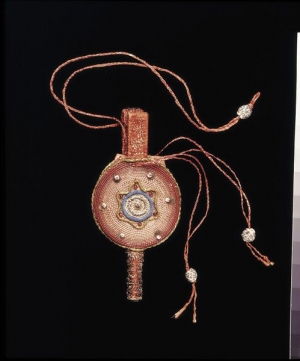
Martha Edlin was an English embroideress who was born in 1660. She is known for a series of extant samplers and other embroidered items, the earliest of which she made when she was eight years old. This is a polychrome band sampler (with multi-coloured rows of different stitches) stitched on linen with silk thread. It is dated to 1668. As in the case of many band samplers from that period, the embroidery is reversible.
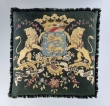
A magistrate's cushion (62 x 62 cm) with an embroidered coat of arms of West Friesland, in the northern part of the province of Noord-Holland, The Netherlands, is housed in the Rijksmuseum, Amsterdam. It was made in West Friesland in 1767. It is made of wool with silk thread embroidery.
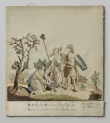
The Rijksmuseum in Amsterdam houses an embroidered picture (21.9 x 19.5 cm) with an allegorical representation of Claudius Civilis (Gaius Julius Civilis), the reputed leader of a revolt by the Batavians against the Romans in the first century AD. The Batavians were long regarded as the ancestors of the Dutch (compare the name of Batavia for the former capital of the Dutch East Indies, nowadays called Jakarta).
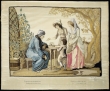
The Rijksmuseum in Amsterdam houses a late-eighteenth century embroidered picture (65 x 75 x 7.5 cm) protesting against the continuing practice of slavery. The name of the embroideress and the date of completion are embroidered underneath the picture: L. van Ommeren / Geb. Hengevelt / 1794. The embroideress was Louise van Ommeren (née Hengevelt), who lived in Arnhem.
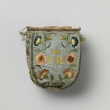
The Rijksmuseum in Amsterdam houses a burse or bag from the mid-eighteenth century that was perhaps used by a Catholic priest to transport the wafers (corporal). The burse measures 15 x 11 x 11 cm and is made of light blue taffeta decorated with multi-coloured embroidery of floral motifs with the crowned initials MR on one side and the letters IHS (the first three Greek letters of the name of Jesus) on the other.

The Victoria and Albert Museum, London, has acquired a number of embroidered items that derive from Chitral, in the extreme north of modern Pakistan. The items date to before 1938.

The Victoria and Albert Museum in London holds a large, embroidered cover or hanging (125 x 79 cm) decorated in the suzani tradition. It dates to the second half of the nineteenth century and is said to originate from Bukhara in modern Uzbekistan. The cover is made of seven linen strips that have been sewn together, whereby the embroidered motifs do no always match well together.
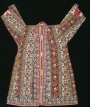
The Victoria and Albert Museum, London, UK, holds a late nineteenth century, densely decorated chapan (coat without front fastenings) from what is now Uzbekistan in Central Asia. The coat, measuring 144 x 98 cm, is made of plain weave cotton with silk thread embroidery, and lined with a silk (resist-dyed) ikat material.

The Victoria and Albert Museum in London holds a relatively old Turkmen chyrpy, a long robe traditionally worn by Tekke Turkmen women over the head and shoulders, with false, decorative sleeves. The robe is made of yellow silk with embroidery in red silk, with small floral motifs. The robe measures 118 x 74 cm.
More...

A white, embroidered woman's robe from the (Tekke) Turkmens in Central Asia is held in the Victoria and Albert Museum, London. It has a white ground material, which denotes it was made for an elderly woman or widow. It dates to the first half of the twentieth century. It is made of cotton with silk embroidery. The garment (locally called a chyrpy) is worn over the head and shoulders. The sleeves are purely decorative.
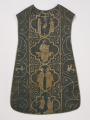
The Clare chasuble is held in the Victoria and Albert Museum, London. It probably dates to the late thirteenth century. It is claimed that the blue ground material originates from Iran or China. It is made of a silk warp and a cotton weft woven in a satin weave. The garment is embroidered with silver-gilt, silver, and coloured silk threads, using underside couching, split stitch and laid work.

The Victoria and Albert Museum in London holds a pair of cotton, silk embroidered trousers that date to the mid-nineteenth century and originate from the Zoroastrian community in Iran, and allegedly from the town of Yazd, which is still populated by a large group of adherents of the ancient faith of Zarathustra, also known in the West as Zoroaster.

'In Praise of God: Ecclesiastical Textiles from the Age of Maria Theresia,' was the name of an exhibition set up in the Kaiserliche Schatzkammer in Vienna, from May to September 2016. On display were eighteenth century vestments from the collection of the museum. Most of the garments were owned by Emperor Charles VI (1685–1740), his wife Elisabeth Christine (1691–1750) and their daughter, Maria Theresia (1717–1780).