
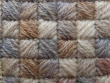
Also known as the Scotch or Scottish stitch, this technique is basically a stitch formation and a form of diagonal stitch. It is formed by a series of straight stitches of varying lengths worked diagonally across the ground material, thus forming a square. An alternating or reversed cushion stitch is comparable, but the diagonal stitches are worked in alternating directions.
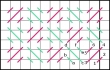
The reversed mosaic stitch is comparable to the diagonal mosaic stitch, but different cells of three stitches (two short diagonal stitches flanking a large diagonal stitch) are worked in opposite direction to each other.

The diagonal mosaic stitch is a very simple form of diagonal stitch, built up of two short, diagonal stitches flanking one larger, diagonal one. When applied vertically, it is called the Hungarian stitch. Also known as the condensed Scotch stitch.

The plaited braid stitch is a complex stitch with loops, which creates a wide border. It is worked downwards, and to achieve the desired effect, a heavier thread should be used. While working, the loops can temporarily be pinned in place.

Photograph of three Toda women from the Nilgiri Hills in southern India. The photograph was taken in the early 1870's and is publsihed as Plate IV of James Wilkinson Breeks, An Account of the Primitive Tribes and Monuments of the Nilgiris (India Museum, London, 1873). They are traditionally known for their jewellery and garments, including shawls and cloaks that are decorated with black and red embroidery.

Photograph of a Burmese princess (or dancer), taken in a studio in Delhi around 1890 by Felice Beato (1825-c. 1907). The photograph shows a woman holding a long cheroot and wearing a heavily decorated set of garments and accessories, including a crown and a wrap-around skirt (hta-mein). The latter is worn underneath a richly embroidered garment made of flaring panels.
More...

The serpentine hem stitch is a form of hem stitch. It is basically a close variant of the ladder hem stitch, in such a way that the second line of stitches does not combine the same vertical threads as those of the first line, but combines an even number of threads from one stich in the first line, with another even number of vertical threads from the adjoining stitch in the first line.

The antique hem stitch is a form of hem stitch, whereby the needle with each stitch passes between, and not through the layers of the hem. The stitches are worked from the reverse side of the ground material, thus creating a neater appearance than in the case of the (normal) hem stitch. The stitches are generally longer and less slanted that the common hem stitches.

The Italian hem stitch is a type of hem stitch. While the normal hem stitch is worked with one line of drawn horizontal threads and a series of stitches that combine clusters of verical threads. The Italian hem stitch has another line of drawn horziontal threads, whereby the thread combines the cluster of vertical threads in the first line and another cluster with the same vertical threads in the second line.

The ladder hem stitch is another variant of the hem stitch, whereby the cloth is turned around after working a series of (common) hem stitches and a similar series is worked along the other side of the vertical clusters of threads.