
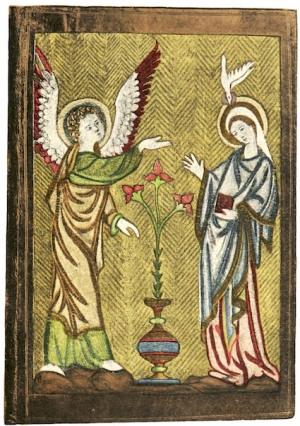
The Felbrigge Psalter is housed in the British Library. It dates to the mid-thirteenth century and was probably made in France. The illuminated psalter is particularly famous for the embroideries set into each of its eighteenth century leather-restored covers. The Psalter was owned in the fifteenth century by Anne (de) Felbrigge, daughter of Sir Simon de Felbrigge, of Felbrigg Hall, Norfolk (near Cromer), hence its name.
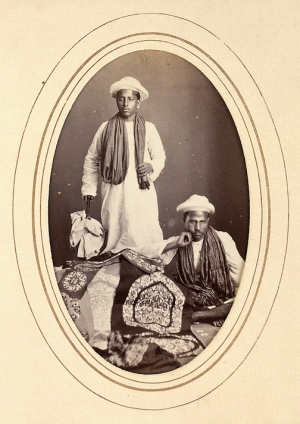
A photograph taken by the firm of Bourne and Shepherd shows two cloth and embroidery sellers, in the early 1870's in India. It is described as a carte-de-visite portrait.
The term blind stitch is sometimes used for the Pekinese stitch, but also for the ladder stitch. WV
The Parzor Foundation for the Preservation of Vulnerable Human Heritage, founded in 2002, developed out of the UNESCO sponsored Parzor project for the preservation and promotion of Parsi Zoroastrian culture and heritage, that was started in 1999. The Foundation supports social activities and academic research in the field of Parsi cultural heritage, including Parsi embroidery.
The Parsis of western India traditionally practise a form of Zoroastrianism, the teachings of the Iranian prophet Zarathustra, who is known in the West as Zoroaster. He regarded Ahura Mazda as the supreme being and who sharply distinguished between Good and Evil. It was the state religion of Persia prior to the Muslim conquest of the country from the seventh century AD.

The San Marco Basilica in Venice, Italy, houses a small number of important medieval and later textiles and garments. Their location in the basilica is indicated in a separate digital map (click here).
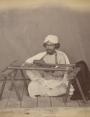
A photograph of an embroiderer behind his frame from Delhi, India, and dated to c. 1863, was taken by Shepherd and Robinson. The photograph is included as illustration no. 188 in volume IV of John Forbes Watson's (co-editor with John William Kaye) The People of India (1868-1875), with the caption 'Scarfmaker'.

A photograph of three Indian gold embroiderers working at their frame is held in the British Library, India Office Select Materials (Photo 1000/52(4914). The photograph probably dates to c. 1873. The photographer may be Shivashanker Narayen. The two men are working on a piece of a garment; the man to the left works on a long, narrow band, probably to be sewn onto a garment.

Photograph of two embroidery salesmen (?) in Ceylon (Sri Lanka), from the Victoria and Albert Museum, London. The photograph was made in 1891. The text on the photograph says "embroiderers", but this may be wrong.
More...
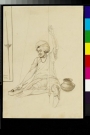
A drawing now in the Victoria and Albert Museum, London, shows a man winding gold thread onto a spindle. The drawing was made in Amritsar around 1870 by John Lockwood Kipling (1837-1911), father of the novelist Rudyard Kipling.

A drawing (36.9 x 26.3 cm) now in the Victoria and Albert Museum, London, shows two boys sitting on either side of an embroidery frame, used for decorating caps and slippers. The drawing was made in Delhi in November 1870 by John Lockwood Kipling (1837-1911), father of the novelist Rudyard Kipling.

A drawing (35.7 x 26.4 cm) now in the Victoria and Albert Museum, London, shows a woman reeling silk thread for embroidery. The drawing was made in Delhi around 1870 by John Lockwood Kipling (1837-1911), father of the novelist Rudyard Kipling.

A drawing (35.6 x 25.7 cm) now in the Victoria and Albert Museum, London, shows three men working at an embroidery frame. The drawing was made in Delhi in November 1870 by John Lockwood Kipling (1837-1911), father of the novelist Rudyard Kipling. They are working a gold thread embroidery, using scissors, spoon, needle and thread.