
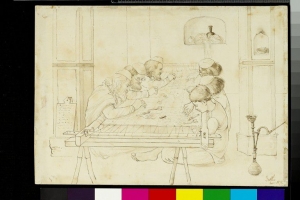
A drawing (36.7 x 26.3 cm) now in the Victoria and Albert Museum, London, shows six men working at an embroidery frame. The drawing was made in Delhi in November 1870 by John Lockwood Kipling (1837-1911), father of the novelist Rudyard Kipling. They are working together on a jewelled cloth. The drawing also shows scissors, a spoon and thread.
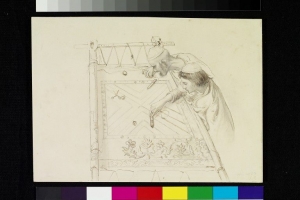
A drawing (35.6 x 25.7 cm) now in the Victoria and Albert Museum, London, shows two men working at an embroidery frame. The drawing was made in Delhi in November 1870 by John Lockwood Kipling (1837-1911), father of the novelist Rudyard Kipling. Gold thread (?) is being used to outline a floral pattern. The young man in the front is holding a spool wound with metal thread. A pair of scissors can be seen in a corner of the cloth.
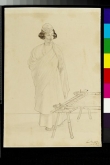
A drawing now in the Victoria and Albert Museum, London, shows a Muslim man in Lucknow, northern India, standing next to a rectangular embroidery frame, with designs for caps outlined on the cloth. The drawing was made around 1870 by John Lockwood Kipling (1837-1911), father of the novelist Rudyard Kipling.
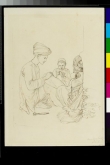
A drawing now in the Victoria and Albert Museum, London, shows a group of embroiderers and piecers, around 1870, working on the production of Kashmir shawls. The drawing was made in Amritsar by John Lockwood Kipling (1837-1911), father of the novelist Rudyard Kipling.
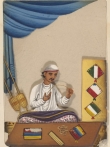
A gouache on mica painting now in the Victoria and Albert Museum shows a male embroiderer of scabbard cases, from Varanasi (Benares), in North India, around 1870. The painting is one of forty paintings of contemporary life in the Indian subcontinent. It measures 18 x 13 cm.
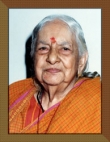
Kamaladevi Chattopadhyay (1903-1988) was an Indian activist, who was involved in the support and development of Indian handicrafts, including textiles and embroidery. Her parents were Anantaiah Dhareshwar and Girijabai (Mangalore, India), who were Saraswat Brahmins. Her parents were regarded as intellectual liberals, and were actively involved in various political (especially nationalist) movements.

A photograph by Antoin Sevruguin (1835-1933) shows corporal punishment being carried out in an embroidery workshop in Iran. The photograph was taken around 1880.
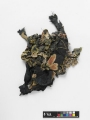
A small group of entangled and embroidered silk strips were recovered from Dunhuang in western China. They are now housed in the Victoria and Albert Museum, London (acc. no. LOAN: Stein.518). It was discovered by the Hungarian/British explorer Sir Aurel Stein (1862-1943) in the early twentieth century (1907), and derives from what is called Cave 17 of the Mogao Grottoes at Dunhuang.

There is a small, but interesting fragment of embroidered silk recovered from Dunhuang in western China, and now housed in the Victoria and Albert Museum, London (acc. no. LOAN: Stein.559). It was discovered by the Hungarian/British explorer Sir Aurel Stein (1862-1943) in the early twentieth century (1907), and derives from what is called Cave 17 of the Mogao Grottoes at Dunhuang ('Caves of the Thousand Buddhas').

The people of Ladakh in the mountains of northern India tend to wear a variety of plain coloured garments that are not embroidered. Instead decoration is emphasised, especially among the married women, by the use of jewellery of various types. The main exception with respect to embroidery is the hat worn by married women.
More...
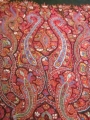
Amli embroidery is a style of work from the Jammu and Kashmir region in the northwest of the Indian subcontinent. It is characterized by the use of threads of many colours, which are used to decorate kani shawls (with woven decoration). The designs are worked on the obverse side of the cloth and are not reversible.
Vata chikan embroidery is a style of work from the Jammu and Kashmir region in the northwest of the Indian subcontinent.
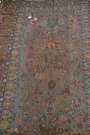
Zalakdozi embroidery is a style of embroidery from the Jammu and Kashmir region in the northwest of the Indian subcontinent. It is made using a chain stitch to create long and flowing designs, whereby the motifs are filled with concentric rings.
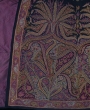
Sozni (or suzani) embroidery is a style of embroidery from the Jammu and Kashmir region in the northwest of the Indian subcontinent. The motifs are created in satin stitch and are worked identically on both sides of the cloth, but sometimes in different colours (for example, the dominant colour may be red on one side and blue on the other). This type of work/stitch is sometimes called Dorukha.