• F4
  • F2
  • F1
  • F3

For several years now the London-based textile organisation SELVEDGE and the TRC Leiden have been working together on various projects, including the writing of articles, book and exhibition reviews, and the organisation of international events (such as SELVEDGE FAIRS). In addition, there have been various discussions with Polly Leonard, the founder and chief editor of SELVEDGE, about how they can actively support the TRC in its plans for establishing a textile artisan centre in Leiden.

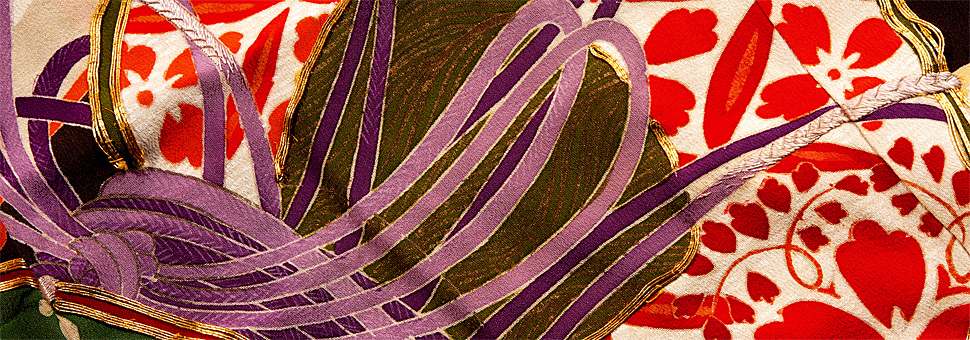
Masako Noda in front of the now demolished ancestral home of her husband's family, March 2021.Masako Noda in front of the now demolished ancestral home of her husband's family, March 2021.Between March and May 2021, I received a series of kimonos from my friend Masako Noda (née Shibata) after the demolition of her husband's grandparents' house on the outskirts of Nagoya, in the Aichi Prefecture. I have given these items to the TRC Leiden. Masako values traditional Japanese culture and kimonos and performs traditional dance and tea ceremonies in kimono, and therefore preferred these items to go to an institute that would appreciate the garments and present them to a wider audiencce.

Masako's own family is from the former samurai class in Okazaki. She married Tetsuji Noda, from a family of a former powerful landlord, village headmaster, and later, a city councilor. In the Edo period (around the mid-19th century) the Noda family’s contribution to local farming and to the local Owari Tokugawa domain was such that they were allowed to have a family name – this was very unusual as farmers didn’t normally have a family name and swords which were only for samurai.

Machine embroidered cigarette silk with a pair of birds, set within a heart. The birds are worked in ombré or shaded threads (1920-1930, TRC 2021.2473h).Machine embroidered cigarette silk with a pair of birds, set within a heart. The birds are worked in ombré or shaded threads (1920-1930, TRC 2021.2473h).We have just had a question about the colour of yarns and in particular: when is a yarn ombré, shaded or variegated?

By coincidence, these differences can be clearly seen in a recent donation to the TRC Collection of some Dutch cigarette silks (zijdjes) from the 1920s to the early 1930s (see the blog).

Ombré (French: ‘shadowed’) and shaded are the same, and it occurs when a yarn or cloth is dyed so that it includes gradated shades of the same colour. So it may go from dark pink to light pink and back again. The two birds in the TRC Blog about cigarette silks were machine embroidered using shaded threads in various hues of blue and orange (TRC 2021.2473h).

American quilt with the Cactus Basket pattern, timespan quilt, from late 19th century (TRC 2018.3127).American quilt with the Cactus Basket pattern, timespan quilt, from late 19th century (TRC 2018.3127).Over the last few months the TRC Leiden has been working with The Quilt Index (USA) to add the TRC's quilt collection to their website. This work has been carried out by Beverley Bennett, a TRC volunteer and an enthusiastic and very knowledgeable quilter. The following blog was written by Beverley.

-----

The Quilt Index is an open access, digital repository of thousands of images, stories and information about quilts and their makers drawn from hundreds of public and private collections around the world. The Quilt Index is a digital humanities research and education project of The Matrix: The Center for Digital Humanities & Social Sciences at Michigan State University

There are literally thousands of quilts to be discovered on their website, along with essays, stories, journals, even lesson plans.

Machine embroidered cigarette silk with a pair of birds, set within a heart, 1920s-1930s (TRC 2021.2473h).Machine embroidered cigarette silk with a pair of birds, set within a heart, 1920s-1930s (TRC 2021.2473h).A few weeks ago the TRC in Leiden was given a wide range of textiles and garments that came from the collection of Joop and May Hobijn-Roth (for a blog on the donation, click here). We have been slowly putting all these items online.

As part of the donation we were given a plastic bag with hundreds of textile patches, of various cloth types and made with different production techniques. Some of them I could place, but the majority were ‘just’ patches, but why so many and so diverse?

A little research has revealed that they are all cigarette silks, also known as premiums or inserts. Cigarette cards made from paper date from the 1870s and were produced by various cigarette companies to encourage people to buy specific tobacco products. The textile silks, however, are later and date from the 1910s onwards. The examples we have been given are actually Dutch in origin and were locally called zijdjes (lit. ‘little silks’). They were all probably produced for Turmac, the Turkish Macedonian Tobacco Company based in Zevenaar, Gelderland, in the east of the Netherlands.


On the 6th August there was a Study Day at the TRC on the topic of Indian an Pakistani embroidery. It quickly became apparent that these two countries are truly extraordinary centres for hand embroidery in all manners and forms.

An example of Agra ‘garden’ embroidery using silk and semi-precious gems, date: 2017 (TRC 2017.2786).An example of Agra ‘garden’ embroidery using silk and semi-precious gems, date: 2017 (TRC 2017.2786).

A relevant theme that is often explored at the TRC is how important trade and other dynamics across history have promoted the development of hand embroidery. One would obviously and immediately think of the Silk Road, colonial influences or even grand power structures such as the Mughal Empire when we discuss how textiles, skills and styles travelled across and towards the subcontinent, but these are far from being the only notable dynamics in this field.

Photograph of a young woman wearing a so-called lange cap (long cap) from the Rijnland region, c. 1888 (TRC 2021.2439f). The photograph was taken by Abraham Koorenhoff from Leiden.Photograph of a young woman wearing a so-called lange cap (long cap) from the Rijnland region, c. 1888 (TRC 2021.2439f). The photograph was taken by Abraham Koorenhoff from Leiden.Rijnland is the name for part of the Netherlands that lies around the ancient city of Leiden. It used to have a special dress tradition, marked by lace caps for women.

Last week I was wondering how to present an exhibition on Rijnland caps and the women wearing them, and would we find that elusive rode draad (‘red thread’ in Dutch, which is appropriate for a textile tale) to hold the story together? We put out a call for help and the response has already been very fruitful. We now have many different aspects we can and will pursue, in fact there are enough potential stories to make a booklet, as well as a small exhibition!

What has happened? Well, thanks to the generosity, for example, of Nel de Wit, we have been given a photo album with images dating from the late nineteenth century, all of them, so it appears, showing men and women from the Van den Akker family from Zoeterwoude and beyond, just to the east of Leiden. Nel de Wit grew up on the farm Cronesteyn, near Lammenschans, and the farm is still there, now being used as a health centre. Her mother, Marijtje de Wit, née Rijnsburger, was born in Weipoort, a small village now part of Zoeterwoude. The images include people with a wide variety of ages, wearing Sunday best outfits, but also daily forms and dress for wearing when in mourning, not to mention men in regional and urban dress and in military uniform. Some of these people are named and it has been possible to identify them.

While increasingly well-known for innovative fashion design, Africa is usually not the first place that comes to mind for embroidery. In fact, some researchers talk about an African “embroidery belt”—a narrow area in the approximate middle of the continent, running from the west coast to the east, where embroidery is practiced.

Participants of the study day on sub-Saharan embroidery look at a pictorial panel produced by the Sabane Kabuye workshop in Rwanda (TRC 2021.0500a). Photograph by Augusta de Gunzbourg.Participants of the study day on sub-Saharan embroidery look at a pictorial panel produced by the Sabane Kabuye workshop in Rwanda (TRC 2021.0500a). Photograph by Augusta de Gunzbourg.

The participants in the TRC’s first study day on sub-Saharan embroidery now know differently. Many styles of embroidery can be found throughout the continent, with some 93 different stitches and stitch combinations identified—including some 15 stitches that have not been seen outside of the continent.

Search in the TRC website

Contact

Boerhaavelaan 6
2334 EN Leiden.
Tel. +31 (0)6 28830428  
office@trcleiden.org 

The TRC is open every day from 10.00 to 15.00

facebook 2015 logo detail 

instagram vernieuwt uiterlijk en logo


Bank account number

NL39 INGB 0002 9823 59, in the name of the Stichting Textile Research Centre.

Donations

The TRC is dependent on project support and individual donations. All of our work is being carried out by volunteers. To support the TRC activities, we therefore welcome your financial assistance: donations can be transferred to bank account number (IBAN) NL39 INGB 000 298 2359, in the name of the Stichting Textile Research Centre. BIC code is: INGBNL2A.

 You can also, very simply, if you have an iDEAL app, use the iDEAL button and fill in the amount of support you want to donate: 


Since the TRC is officially recognised as a non-profit making cultural institution (ANBI), donations are tax deductible for 125% for individuals, and 150% for commercial companies. For more information, click here