• F4
  • F2
  • F3
  • F1

Embroidered Palestinian dress which is made up of at least four different garments, probably for the tourist market, second half 20th century (TRC 2021.3351).Embroidered Palestinian dress which is made up of at least four different garments, probably for the tourist market, second half 20th century (TRC 2021.3351).The TRC has just been given various pieces of Palestinian embroidery. They were donated by Ms Truus Oranje, Weesp, the Netherlands, who lived in Jerusalem between 1975 and 1985. She regularly went to various markets in the region and bought, among other items, embroidered pieces and several garments. Mw Oranje’s donation consists of  two embroidered dresses (TRC 2021.3350 and TRC 2021.3351), parts of another dress (TRC 2021.3349a-d) and a black velvet jacket (TRC 2021.3352).

One of the dresses (TRC 2021.3351) is a bit of a mixture and has an interesting history concerning the re-use of garments. One closer examination it turns out to have been made from at least four other dresses. The sleeves are from one garment, the bodice panel from a second, while the lower front panel from a third dress and finally, the side panels and back panel come from yet another dress!

I was introduced to the TRC about a month ago when one of my professors at Leiden University sent out an email about an internship opportunity at a local textile centre. I am 22 years old, born and raised in British Columbia, Canada, and prior to August 2020 I had never set foot in Europe. I have always been interested in historical fashion and textiles, so you can imagine when I saw an opportunity to work with a large collection of textiles from all around the world, I scrambled to reach out and get in contact!

Embroidered mocassins produced and worn by Canadian Inuit, late 20th century (TRC 2009.0261a-b).Embroidered mocassins produced and worn by Canadian Inuit, late 20th century (TRC 2009.0261a-b).

The Lodewijkskerk in Leiden used to be the centre ('saai-hal') for the trade in saai cloth.The Lodewijkskerk in Leiden used to be the centre ('saai-hal') for the trade in saai cloth.The historic city of Leiden has long been known for the production of various types of woollen and worsted textiles, including laken (broadcloth), baai (baize), saai (combed wool), satin, grein (goat or sheep's hair/wool worsted cloth) and serge (twill), as well as soft fluffy blankets (deken).

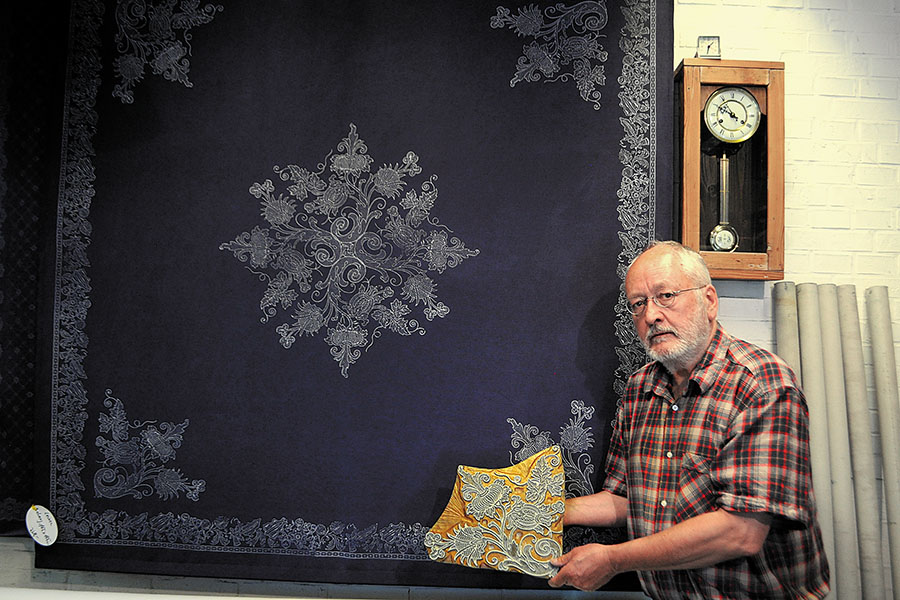
Not so surprising therefore that the TRC in Leiden is actively working with Dutch textile and costume historian Jankees Goud (Atelier Dracht), Frank Gardiner (Amsterdam) and others to expand its reference collection of textiles that reflects these technical types and forms (always of interest to the TRC) and the textile history of Leiden in general.

This reference collection will eventually cover the wide range of textile types (woven, printed, embroidered, laces, etc) associated with Dutch regional dress. It will also 'underpin' a TRC research project into the Leiden textile production throughout the centuries, with a special emphasis on technical aspects, such as the fibres, their spin, the weaving, the dyes, further processing, etc.

I came across a curious piece of press photography when exploring the TRC’s online archive. The image shows five German prisoners of war from the First World War participating in a spot of needlework whilst a crowd of spectators, also POWs, gather around in fascination, peering over each other’s shoulders to watch the exercise.

'The treatment of German wounded: Exercising the muscles of the arms by means of embroidery.' The Manchester Guardian 1915. (TRC 2021.1342).'The treatment of German wounded: Exercising the muscles of the arms by means of embroidery.' The Manchester Guardian 1915. (TRC 2021.1342).

This lovely cloth, TRC 2021.2068, was recently acquired by the TRC in Leiden. It came with a label: ‘19th- Cyprus – Italian influence’. Research in books and on the internet helped me to find more background information.

Ill. 1. Tasseled short edge of Lefkara lace cloth from Cyprus, 19th century (TRC 2021.2068). In the centre is the insert between the two lengths that make up the complete clothIll. 1. Tasseled short edge of Lefkara lace cloth from Cyprus, 19th century (TRC 2021.2068). In the centre is the insert between the two lengths that make up the complete cloth

Recently, the TRC Library received a special gift from Sytske Wijnsma in the small town of Wormer, in the northwest of the Netherlands, who on previous occasions has given other items to the TRC (click here).

Title page of Paulus Fürst's embroidery model book (Nuremberg 1666).Title page of Paulus Fürst's embroidery model book (Nuremberg 1666).

The donation is that of an original, seventeenth century pattern book that was specifically published for embroideresses, and it contains embroidery charts that were designed by a woman who is named in the text. The frontispiece of the booklet (see illustration below) also has a distinctly ‘feminine touch’, showing a domestic scene with five women doing their needlework, and who are being spied upon by two men, one of them half hiding behind the curtains.

I am pleased to announce that a Memorandum of Understanding (MoU) is being signed between the Textile Department, Osnabrück University, Germany, and the TRC Leiden. Over the next few years we are going to work together on a variety of projects, and the first one changed today from being ‘a plan’ to an actual happening!

 For sometime now, Prof. Bärbel Schmidt (Osnabrück University) and myself have been talking about some of her BA textile students working together on a collection of Dutch and German regional dress from the TRC Collection. The aim is for the students to help with the identification of the garments, using them as a source of inspiration and then making a booklet and online exhibition about their experience, research and creations. This work is being supported by a grant from the Lower Saxony Ministry for Science and Culture for the development of Dutch-German cultural relationships..

Delegation from Osnabrück borrows garments from the TRC for further study by students of Osnabrück University.Delegation from Osnabrück borrows garments from the TRC for further study by students of Osnabrück University.The main problem, however, was the corona crisis, which meant that the students could not come to Leiden to work on a selection of garments. So Prof. Schmidt and her colleagues, Lucia Schwalenberg, came to Leiden last week to discuss the project and to pick out a range of objects that could be borrowed and taken back to Germany for a couple of months. Around the same time, I had an online meeting with some of the Osnabrück students to discuss the work of the TRC and to explain the project and what was being expected.

Eventually, eight garments of regional dress from Germany and eight pieces from the Netherlands were selected, including caps (for men and women), shawls, bodices, aprons, skirts, etc. These items will be examined at the University under the supervision of various staff members. This is an experiment for both institutes as normally objects do not leave museums’ collections, or in this case the TRC building, unless it is for a loan to another research institute, but given the current crisis, flexible solutions have to be found.

Chota (tea cosy) from 1950s India, sold locally by the London Missionary Society (TRC 2020.3740a).Chota (tea cosy) from 1950s India, sold locally by the London Missionary Society (TRC 2020.3740a).When I was clearing out my mother’s house some time ago, I found several items which I subsequently donated to the TRC. Many of these came from India where we lived in the late 1950s, as my father was a senior British diplomat. A couple of these items got me reminiscing about certain meals there.

The first are items TRC 2020.3740a and 3740b, labelled as a chota set. What is a chota set? It comprises a tea cosy cover and a tray cloth and was used for chota hazri which literally translates as ‘little presence’ but was always known as little breakfast. In the heat of India, the best time to exercise was in the early morning, so just after dawn my father and I would receive little breakfast on a tray in bed. It consisted of tea with imported powdered milk (an acquired taste) and toast, with possibly some mango or papaya.

Zoek in TRC website

Contact

Boerhaavelaan 6
2334 EN Leiden.
Tel. +31 (0)6 28830428  
office@trcleiden.org

facebook 2015 logo detail


instagram vernieuwt uiterlijk en logo


Bankrekening

NL39 INGB 0002 9823 59, t.a.v. Stichting Textile Research Centre.

Openingstijden

Het TRC is gesloten tot maandag 4 mei vanwege de verhuizing naar de Boerhaavelaan. We blijven bereikbaar via email (office@trcleiden.org) of telefoon: 06-28830428.

Financiële giften

Het TRC is afhankelijk van project-financiering en privé-donaties. Al ons werk wordt verricht door vrijwilligers. Ter ondersteuning van de vele activiteiten van het TRC vragen wij U daarom om financiële steun:

Giften kunt U overmaken op bankrekeningnummer (IBAN) NL39 INGB 000 298 2359, t.n.v. Stichting Textile Research Centre. BIC code is: INGBNL2A

U kunt ook, heel simpel, indien u een iDEAL app heeft, de iDEAL-knop hieronder gebruiken en door een bepaald bedrag in te vullen: 


Omdat het TRC officieel is erkend als een Algemeen Nut Beogende Instelling (ANBI), en daarbij ook nog als een Culturele Instelling, zijn particuliere giften voor 125% aftrekbaar van de belasting, en voor bedrijven zelfs voor 150%. Voor meer informatie, klik hier