• F4
  • F1
  • F2
  • F3

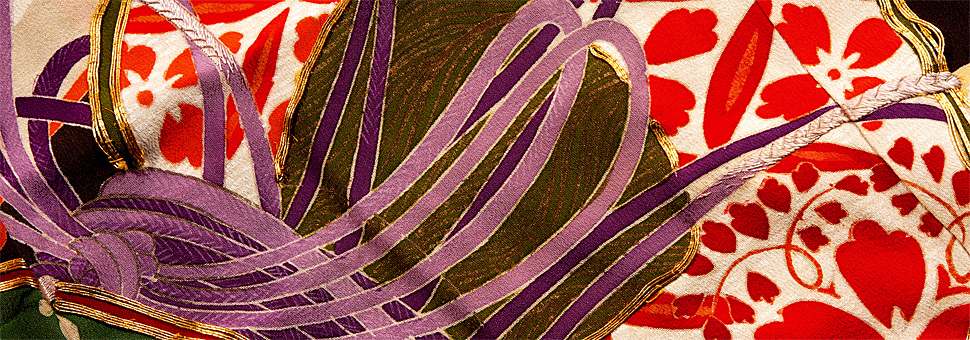
Bib for a baby girl, Japan, 1920s-1940s (TRC 2021.2135a).Bib for a baby girl, Japan, 1920s-1940s (TRC 2021.2135a).Among the Japanese items recently donated to the TRC Leiden by the Noda and Shibata families there are various items relating to children’s rites of passage at various ages within Japanese family life.

Baby clothing and the Omiya mairi, the first shinto shrine visit

The baby’s bib (TRC 2021.2135a) and cap (TRC 2021.2135b, see also TRC 2021.2136) were used for the first omiya mairi (Shinto shrine visit) in the 1920s - 1940s of the children of Minoru and Tokiko Noda. This age-old custom originated in the Kamakura period (12th century), and was meant to tell a local god about the safe arrival of a baby. The ritual took place one month after birth.

Back then child mortality was high, and the family expressed their gratitude to the god and prayed for the baby’s health. The pink bib and cap were used for the girls (TRC 2021.2135b) and the white cap was worn by the boys (TRC 2021.2136), who would also wear a bib with the white side outwards (TRC 2021.2135a). The caps and bib have embroidered cranes that symbolise longevity.

Fatima Abbadi from Capelle aan den IJssel, near Rotterdam in the Netherlands, is a TRC volunteer and teacher who specialises in Middle Eastern embroidery, especially that from Palestine and Syria. As part of her many activities she is giving various workshops at the TRC about Palestinian cross stitch (22nd October) and Jordanian rekme embroidery (12th November). She is also working with various other groups to promote Middle Eastern embroidery and to help preserve this important part of the cultural heritage of the region. Below is an account of one of her recent successes.

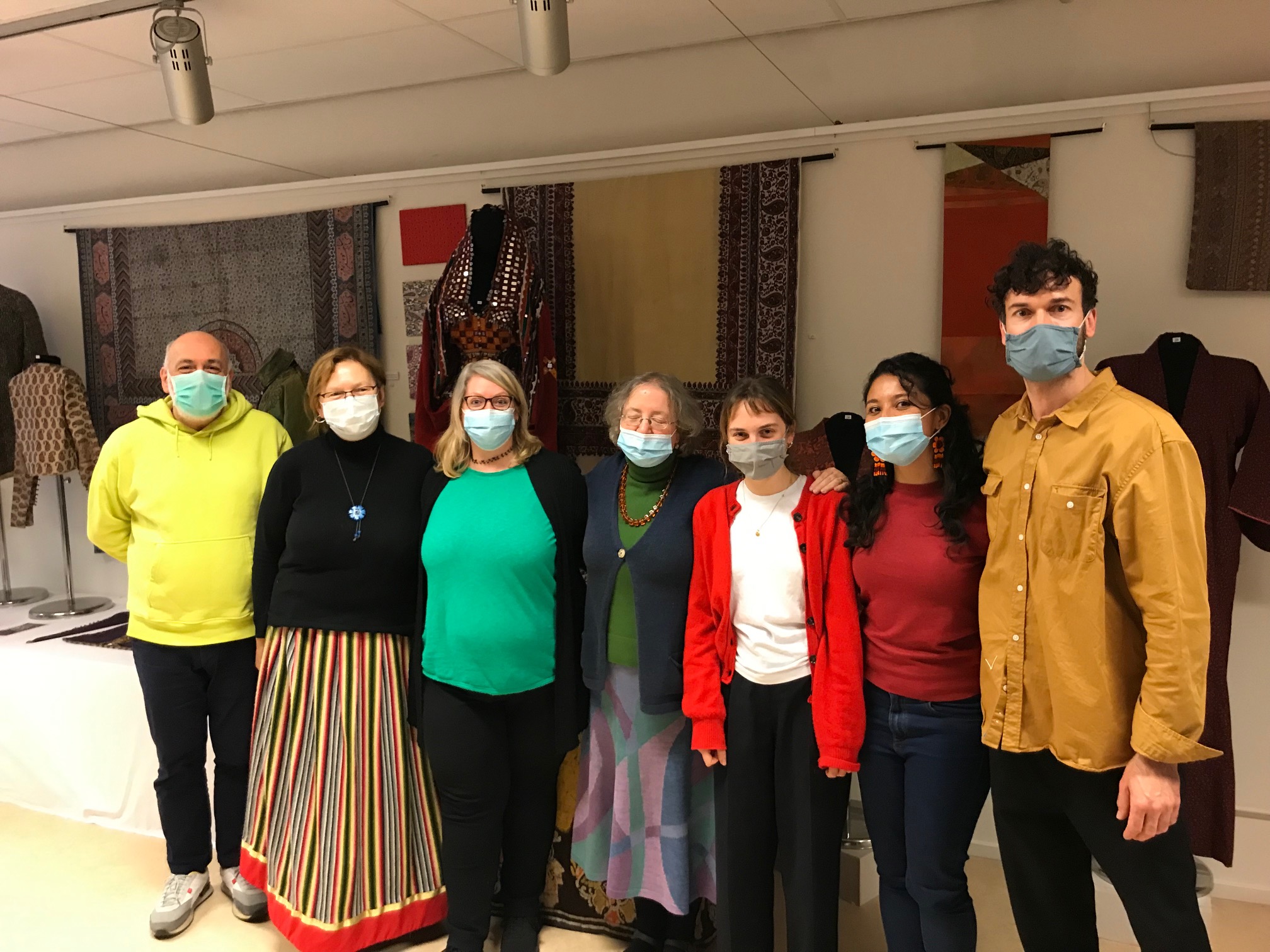
A panel with six Palestinian embroidery samplers, worked by the women of an embroidery group in Capelle aan den IJssel, 2021.A panel with six Palestinian embroidery samplers, worked by the women of an embroidery group in Capelle aan den IJssel, 2021.

Last winter, during one of the embroidery lessons, I asked the women of the embroidery group, what was their dream? Among many of those that spoke out, one of them expressed the desire to do something for the municipality. A sort of a 'thank you' gift for what the municipality is doing for the refugee women in Capelle aan den IJssel.

A few days ago the TRC in Leiden published a blog about pins and pin heads that were found in Zeeland, the Netherlands, and date to before 1532, and were recently given to the TRC. The donation also includes several hooks and eyes and I would now like to put these unprepossessing items under the Dino-Lite microscope. 

Two metal hooks from Zeeland, before 1532. Magnification: 15.2. Dino-Lite microscope (TRC 2021.2739a and b).Two metal hooks from Zeeland, before 1532. Magnification: 15.2. Dino-Lite microscope (TRC 2021.2739a and b).

There are various forms of hooks and eyes present, but basically the hooks (TRC 2021.2739a-l) are made by using a length of wire with loops at each end, which was then folded in half, probably with pliers of some kind, into a long U-shape leaving the two loops next to each other at the top. The lower half of the U-shape was folded back on itself to create a hook.

Two eyes with twisted ends, Zeeland, before 1532. Magnification 16.8 (TRC 2021.2741e-f).Two eyes with twisted ends, Zeeland, before 1532. Magnification 16.8 (TRC 2021.2741e-f).

Three wire-wrapped pin heads, pre-1532, from Zeeland. 36.3 magnification, Dino-Lite microscope (TRC 2728a-b and TRC 2021.2735a).Three wire-wrapped pin heads, pre-1532, from Zeeland. 36.3 magnification, Dino-Lite microscope (TRC 2728a-b and TRC 2021.2735a).Some medieval Christian theologians allegedly debated on the question how many angels could dance on a pin head, and I always thought such a discussion would have been a bit of a waste of time. Yet over the last few years I have become fascinated with pins and pin heads! The handmade pin heads, for example, associated with a textile linked to Napoleon Bonaparte, as well as a pin cushion from 1826 were subject of an earlier TRC Blog.

I ‘knew’ that up to the 18th century pins in Europe were handmade, rare and expensive. Hence, I assumed, the English term ‘pin money’, namely the money given by a husband to his wife to spend at the New Year fairs on buying pins. But I have long suspected this knowledge was far too general and just recently a donation by a friend of the TRC, Sytske Wijnsma from Wormer in the province of Noord-Holland, has left me wondering even more about this subject.

A few days ago, on a sunny Saturday morning, I hopped onto a train to Leiden to reconnect with Gillian Vogelsang after far too many years. She used to be my mentor on all things textile when I pieced together my MA thesis on Mongolian attire at Leiden University. I fondly remember mornings spent at the TRC photographing and cataloguing the latest batch of clothing that had come in as a donation. Just as clearly I remember the TRC’s ever pressing issue of not having enough space for about everything. That appears not to have changed much, as Gillian points out when welcoming us to the TRC’s premises at Hogewoerd 164. The TRC was still housed at the Volkenkunde Museum when I was around, and yet, it eerily feels a bit like coming home at the Hogewoerd!

The Good Growth Company supports yak herders in Mongolia.The Good Growth Company supports yak herders in Mongolia.

I was accompanied by Mandar Jayawant, founder and CEO of the Good Growth Company, which he set up together with Nick Keppel-Palmer. Recognising the need to address the environmental devastation caused by conventional fashion industry supply chains, Good Growth Company has made it its declared aim to regenerate depleted places. This sounds complicated, but it doesn't have to be. According to Mandar and Nick it actually needs simplicity rather than complication. They believe that instead of using complicated production chains for the trend-hungry low-cost consumer, the Good Growth Company wants to create products that put the local natural environment first. In other words, Good Growth Company replaces the question of what the consumer wants, with the question of what a given region can provide or needs to regenerate and then to develop products from these materials.

Yaks in Khangai region, Mongolia ( Good Growth Company 2019).Yaks in Khangai region, Mongolia ( Good Growth Company 2019).To drive home this concept Mandar points to the desertification of the Mongolian steppes as a result of herders having turned away from the traditional production practices and herd compositions to a single-minded focus on cashmere goats. Desertification in Mongolia is a direct consequence of consumer/retailer dictated production. To turn this around the Good Growth Company commits to buying everything herders produce — cashmere, yak, camel, and their coarse as well as their fine fibres. For a community of herders in Arkhangai province in Mongolia this means income options from all of their yak fibres while not long ago there were none.

Making good on this promise, Good Growth Company has now become the proud owner of a large consignment of fine yak underhair (wool) and of coarser yak guard hair. There is no shortage of ideas of how to use the fine underhair - a fibre of cashmere quality that has caught the attention of the sustainable fashion crowd in recent years. But the no-waste policy of the Good Growth Company goes beyond this and challenges the company to come up with innovative fabric and design ideas to create value for the coarser yak hair which is conventionally treated as waste to be discarded.

The last few weeks we have been writing about the clothing of the Taliban leaders and how they want Afghan women to dress; dress is everything, and the TRC in Leiden has been studying dress in all its aspects for many years. Dress is, as stated in the title of this blog, a statement of who you are or want to be.

Well well, yesterday I saw three of our leading politicians coming together to discuss the formation of a government, some six months after the last elections. Some urgency is advisable, one would say. And what did I see? I saw our acting Prime Minister Mark Rutte in a kind of 'casual' outfit that he probably regards as suitable for a Saturday afternoon; I saw our former Minister of Foreign Affairs, Sigrid Kaag, in an outfit that she probably wears when gardening; and then Wopke Hoekstra, the political leader of the Christian Democrats and acting Minister of Finance, wearing a T-shirt that, and I am being charitable, does not really suit him. 

From left to right: Wopke Hoekstra, Sigrid Kaag and Mark Rutte in fantasy casual clothing. Dutch politics in its sartorial glory Copyright ANP.From left to right: Wopke Hoekstra, Sigrid Kaag and Mark Rutte in fantasy casual clothing. Dutch politics in its sartorial glory Copyright ANP.

So how do these outfits make the statement who they are and who they want to be? I suspect that the three discussed their clothing at length on Friday night. "Do we put on our normal everyday wear, or shall we try something different?" The result is clear. The message is "We are all buddies". We can only hope that their discussions were more fruitful than their combined sense of dress. Anyhow, politics are often compared to a theatre, and there you are!

Willem Vogelsang, 19 September 2021

All archaeological textiles fascinate me, but there is one group that I find particularly interesting: old Coptic textiles. The embroidered images on these textiles seem so joyful to me, so full of love for life: dancing people, cherubs, early Christian symbols, fertile plants, gods and goddesses (including Bacchus, the god of wine and ecstasy). The human images usually have big eyes, and are chubby and always look a little lopsided to me. I think this indicates a fine disdain for perfectionism, despite the fact that the weavers, spinners and embroiderers involved were eminently skilful and accomplished. I also like the fact that these images represented a highly multicultural society, reflecting Egyptian, Greek, Roman, Byzantine and other influences from international trade.

Fragment of a Coptic textile with an embroidered design of a clavus and a pendant, probably from a child's tunic. 6th-8th c. (TRC 2011.0460).Fragment of a Coptic textile with an embroidered design of a clavus and a pendant, probably from a child's tunic. 6th-8th c. (TRC 2011.0460).

The last few weeks we published various blogs about the garments worn by Taliban men and about the dress that they 'suggest' Afghan women to wear. As for the latter, we noted that the niqab and abaya, now promoted by the Taliban as 'Islamically correct', is Arabic in origin and distincty different from the traditional, all-enveloping burqa that was enforced by the Taliban leaders upon Afghan women in the 1990s.

We indicated that the niqab and abaya set was introduced in Peshawar and other parts in the Pashtun-dominated Afghan-Pakistan borderlands in the 1980s when many Arabs flocked to the area to help the Afghan Mujahedin against the then communist regime in Kabul and their Soviet backers. One of them was Osama bin Laden.

Mullah Abdul Ghani Baradar (left), and Khalil ur-Rahman Haqqani (right). Photograph: The Times.Mullah Abdul Ghani Baradar (left), and Khalil ur-Rahman Haqqani (right). Photograph: The Times.

Zoek in TRC website

Contact

Boerhaavelaan 6
2334 EN Leiden.
Tel. +31 (0)6 28830428  
office@trcleiden.org

facebook 2015 logo detail


instagram vernieuwt uiterlijk en logo


Bankrekening

NL39 INGB 0002 9823 59, t.a.v. Stichting Textile Research Centre.

Openingstijden

Het TRC is gesloten tot maandag 4 mei vanwege de verhuizing naar de Boerhaavelaan. We blijven bereikbaar via email (office@trcleiden.org) of telefoon: 06-28830428.

Financiële giften

Het TRC is afhankelijk van project-financiering en privé-donaties. Al ons werk wordt verricht door vrijwilligers. Ter ondersteuning van de vele activiteiten van het TRC vragen wij U daarom om financiële steun:

Giften kunt U overmaken op bankrekeningnummer (IBAN) NL39 INGB 000 298 2359, t.n.v. Stichting Textile Research Centre. BIC code is: INGBNL2A

U kunt ook, heel simpel, indien u een iDEAL app heeft, de iDEAL-knop hieronder gebruiken en door een bepaald bedrag in te vullen: 


Omdat het TRC officieel is erkend als een Algemeen Nut Beogende Instelling (ANBI), en daarbij ook nog als een Culturele Instelling, zijn particuliere giften voor 125% aftrekbaar van de belasting, en voor bedrijven zelfs voor 150%. Voor meer informatie, klik hier