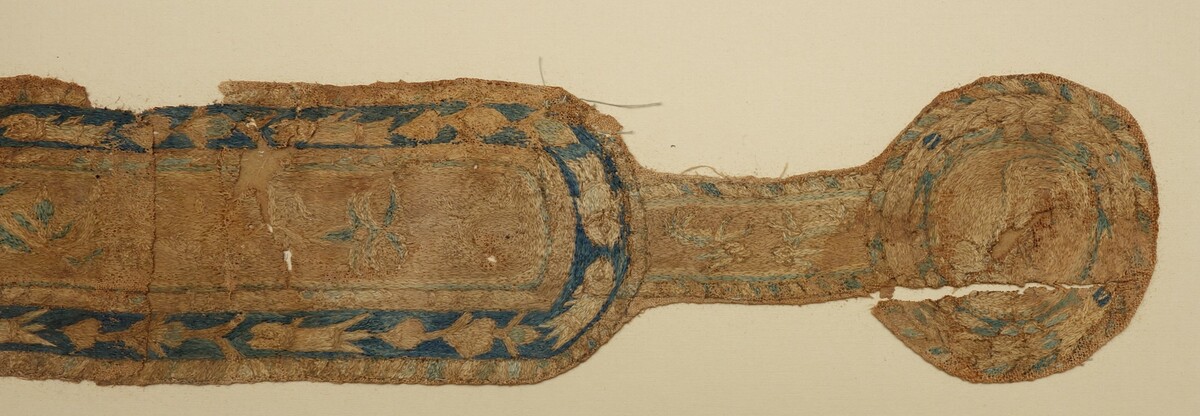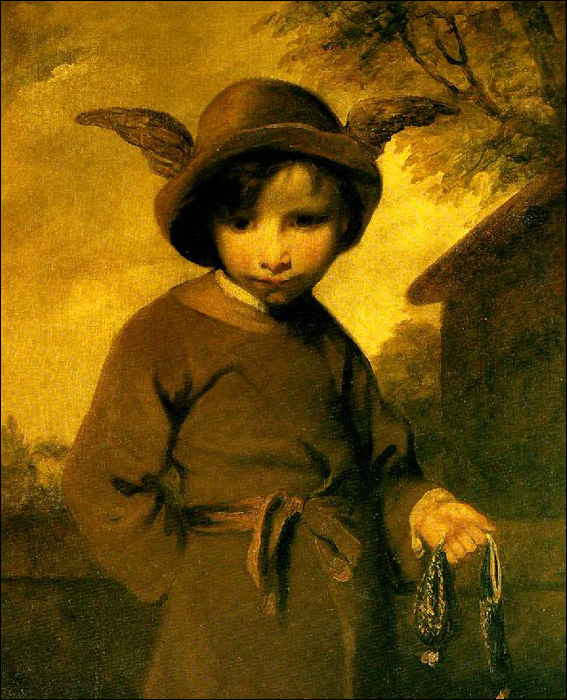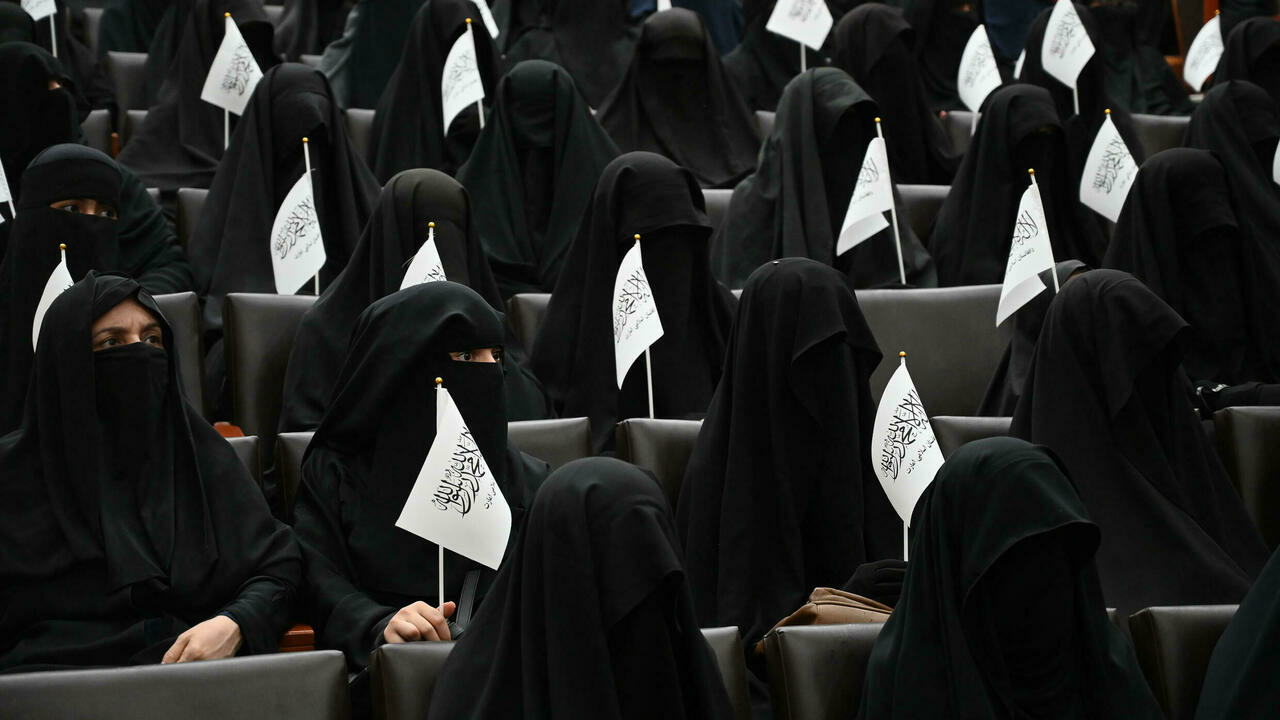
• F2
  • F4
  • F1
  • F3

A little while ago I wrote a blog about zijdjes, cigarette silks produced by the Dutch company of Turmac, between about 1920 and 1934. It was noted in the blog that the embroidered examples now in the TRC Collection were machine, rather than hand stitched. I have had several questions since then about how to tell the difference?

First of all a difference has to be made between a free-motion embroidery machine with a single needle that can be moved all over a piece of cloth, and an industrial embroidery machine which might have hundreds of needles all working in synchronisation. The former tends to be more irregular in shape and a lot closer to free-style hand embroidery. The latter tends to include the repetition of one or more motifs.

Below I want to focus on multiple-needle machine embroidery, which is produced by a variety of machines, namely Cornely (chain stitch), Schiffli (basically satin stitch, zig-zag stitch, running stitch) and Leaver (basically satin stitch, zig-zag stitch, running stitch) machines, and the multiple-needle hand embroidery machine (a wide variety of stitches).

We have just had the August 2021 TRC Intensive Textile Course, and as usual it was intense, inspiring, filled with lots of information and practical elements, but fun at the same time with the chance for the participants, and me, to exchange a wide range of experiences.

Mapula embroidery from South Africa, depicting the funeral of Nelson Mandela.Mapula embroidery from South Africa, depicting the funeral of Nelson Mandela.

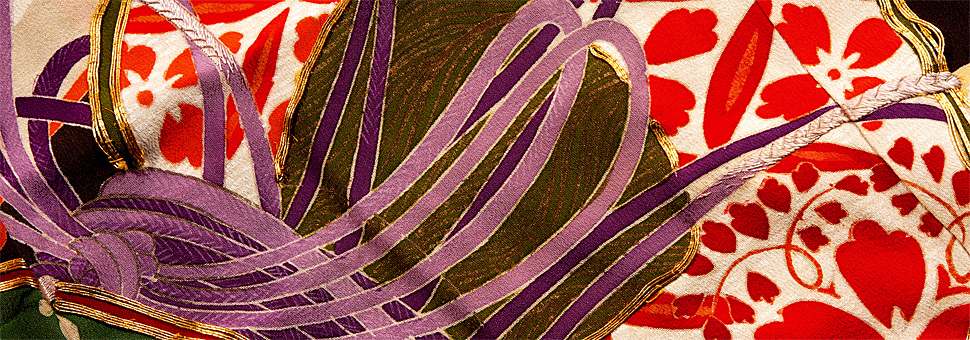
Traditional Moroccan woman’s kaftan made from Japanese  material intended for a kimono sash (second half 20th century). Courtesy Textile Research Centre, Leiden (TRC 2001.0074).Traditional Moroccan woman’s kaftan made from Japanese material intended for a kimono sash (second half 20th century). Courtesy Textile Research Centre, Leiden (TRC 2001.0074).The International Institute for Asian Studies (IIAS), Leiden, has just published its Newsletter (summer 2021). It has a special focus section that contains a number of articles based on an international online conference in 2020 about textile and dress traditions that developed through time and space, and thereby often changed their role and meaning.

The conference was organised by the IIAS with the support of Sandra Sardjono of the Tracing Patterns Foundation in Los Angeles, Gillian Vogelsang-Eastwood of the Textile Research Centre in Leiden, and Chris Buckley in Oxford.

The TRC in Leiden houses a fascinating colletion of samplers. They all have a story to tell. This time I want to look at TRC 2014.0075, which dates to the early twentieth century. Yes, it could be called a sampler, but if so, it is an unusual one. I don’t think I have ever seen one like it.

Sampler from the early 20th century, with stamped outlines for embroidered motifs (TRC 2014.0075).Sampler from the early 20th century, with stamped outlines for embroidered motifs (TRC 2014.0075).

Sampler dated 1756 worked by Jacoba Jans Adegeest, from the Rijnland, the Netherlands (TRC 2020.3683).Sampler dated 1756 worked by Jacoba Jans Adegeest, from the Rijnland, the Netherlands (TRC 2020.3683).Two weeks ago the TRC published a blog about lace caps from the Rijnland based on a photo album with photographs of the Van den Akker family, many of whom lived in Zoeterwoude or thereabouts, in the late nineteenth century. In this blog I more or less return to Zoeterwoude, a small village just southeast of Leiden, in the heart of the Rijnland, following the trail of an eighteenth century sampler now in the TRC Collection (TRC 2020.3683).

The sampler has two alphabets: one in small gothic letters, the other in straight capitals. And one line of numbers. For the rest, the sampler is mostly symmetrical. There are two sets of men carrying a big bunch of grapes, a very common motif on Dutch samplers (the two Israeilis returning from the reconnaissance in the land of Canaan). This motif, it so happens, is also depicted in a stone plaque in the centre of the old town of Leiden (see a TRC blog of 4 July 2020).

For several years now the London-based textile organisation SELVEDGE and the TRC Leiden have been working together on various projects, including the writing of articles, book and exhibition reviews, and the organisation of international events (such as SELVEDGE FAIRS). In addition, there have been various discussions with Polly Leonard, the founder and chief editor of SELVEDGE, about how they can actively support the TRC in its plans for establishing a textile artisan centre in Leiden.

Masako Noda in front of the now demolished ancestral home of her husband's family, March 2021.Masako Noda in front of the now demolished ancestral home of her husband's family, March 2021.Between March and May 2021, I received a series of kimonos from my friend Masako Noda (née Shibata) after the demolition of her husband's grandparents' house on the outskirts of Nagoya, in the Aichi Prefecture. I have given these items to the TRC Leiden. Masako values traditional Japanese culture and kimonos and performs traditional dance and tea ceremonies in kimono, and therefore preferred these items to go to an institute that would appreciate the garments and present them to a wider audiencce.

Masako's own family is from the former samurai class in Okazaki. She married Tetsuji Noda, from a family of a former powerful landlord, village headmaster, and later, a city councilor. In the Edo period (around the mid-19th century) the Noda family’s contribution to local farming and to the local Owari Tokugawa domain was such that they were allowed to have a family name – this was very unusual as farmers didn’t normally have a family name and swords which were only for samurai.

Machine embroidered cigarette silk with a pair of birds, set within a heart. The birds are worked in ombré or shaded threads (1920-1930, TRC 2021.2473h).Machine embroidered cigarette silk with a pair of birds, set within a heart. The birds are worked in ombré or shaded threads (1920-1930, TRC 2021.2473h).We have just had a question about the colour of yarns and in particular: when is a yarn ombré, shaded or variegated?

By coincidence, these differences can be clearly seen in a recent donation to the TRC Collection of some Dutch cigarette silks (zijdjes) from the 1920s to the early 1930s (see the blog).

Ombré (French: ‘shadowed’) and shaded are the same, and it occurs when a yarn or cloth is dyed so that it includes gradated shades of the same colour. So it may go from dark pink to light pink and back again. The two birds in the TRC Blog about cigarette silks were machine embroidered using shaded threads in various hues of blue and orange (TRC 2021.2473h).

Zoek in TRC website

Contact

Boerhaavelaan 6
2334 EN Leiden.
Tel. +31 (0)6 28830428  
office@trcleiden.org

facebook 2015 logo detail


instagram vernieuwt uiterlijk en logo


Bankrekening

NL39 INGB 0002 9823 59, t.a.v. Stichting Textile Research Centre.

Openingstijden

Het TRC is gesloten tot maandag 4 mei vanwege de verhuizing naar de Boerhaavelaan. We blijven bereikbaar via email (office@trcleiden.org) of telefoon: 06-28830428.

Financiële giften

Het TRC is afhankelijk van project-financiering en privé-donaties. Al ons werk wordt verricht door vrijwilligers. Ter ondersteuning van de vele activiteiten van het TRC vragen wij U daarom om financiële steun:

Giften kunt U overmaken op bankrekeningnummer (IBAN) NL39 INGB 000 298 2359, t.n.v. Stichting Textile Research Centre. BIC code is: INGBNL2A

U kunt ook, heel simpel, indien u een iDEAL app heeft, de iDEAL-knop hieronder gebruiken en door een bepaald bedrag in te vullen: 


Omdat het TRC officieel is erkend als een Algemeen Nut Beogende Instelling (ANBI), en daarbij ook nog als een Culturele Instelling, zijn particuliere giften voor 125% aftrekbaar van de belasting, en voor bedrijven zelfs voor 150%. Voor meer informatie, klik hier