

Elizabethan Embroidered Coif

The Philadelphia Museum of Art (USA) houses an unassembled coif that dates to the late sixteenth century. It is made from a length of linen that has been embroidered with silk and gilt thread. In order to assemble the coif it would have been folded in half vertically, and then stitched around the edges, but leaving the front edges unstitched (open). The coif would have been secured with a drawstring along the bottom edge.
Coif

A coif is a close-fitting cap that covers the top, back and sides of the head. It was worn by both men and women during the medieval period and later in Northern Europe. The word coif derives from the Old French word coife (modern coiffe) meaning a headdress. It is also related to the late Latin cuphea, cofea, meaning a helmet. The headdress and the word are probably related to the Anglo-Saxon cuffia/cuffie, known from the tenth century.
Italian Chasuble of Venetian Raised Needle Lace
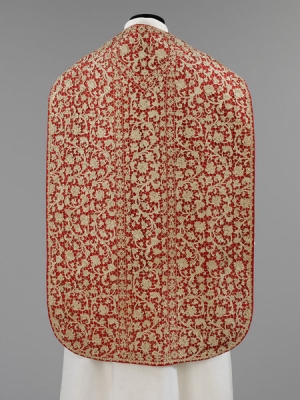
The Victoria and Albert Museum (London) houses a chasuble (acc. no. 743-1870) dating from the late seventeenth century, which is decorated with (Venetian) raised needle lace mounted on a red silk ground (this may be a Victorian mount). The floral motifs are separated by narrow bands with flower heads. All of the lace is worked in a linen thread.
Fine and Fashionable

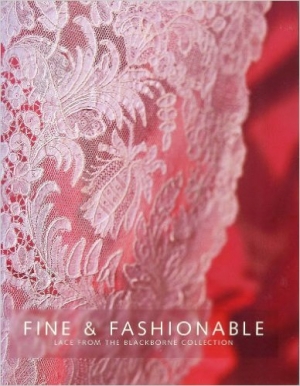
Fine and Fashionable: Lace from the Blackborne Collection was an exhibition held at the Bowes Museum (Barnard Castle, Co. Durham, England) between September 2006 and April 2007. The exhibition included over 200 items of early bobbin and needle lace that were donated to the Museum by descendents of Anthony and Arthur Blackborne, London-based dealers in lace in the nineteenth and early twentieth centuries.
Seventeenth Century Needle Lace Collar
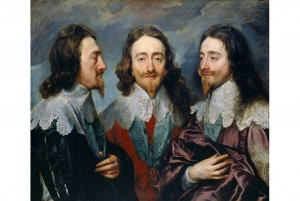
In the Blackborne collection of the Bowes Museum (UK), there is a needle lace collar (79 x 21.5 cm), which is believed to date to the 1630's. It may even have been worn by the British king, Charles I (1600-1649). During the late nineteenth century the collar was the property of the London based lace dealers, Blackborne & Co.
A. Blackborne & Company
A. Blackborne & Company was the trade name of father Anthony (1824-1878) and son Arthur Blackborne (1856-1952), lace dealers. They began work around 1850 and operated their business from 35 South Audley Street, London (UK), near the fashionable shopping areas of Bond Street and Oxford Street. They held a Royal Warrant from 1863 to 1912 from Alexandra, Princess of Wales and later the Queen.
Blackborne Collection
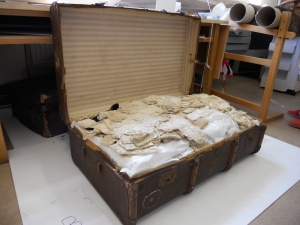
The Blackborne collection is a major assemblage of lace, dating from the sixteenth to the early twentieth centuries. It includes some 7000 items, from the remaining stock and study collection of the Victorian-era lace dealers, A. Blackborne and Company of London. This was a father and son business that operated out of London from the 1850's onwards.
Bowes Museum
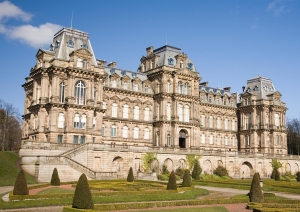
The Bowes Museum (in Barnard Castle, County Durham, England) was opened in 1892 as a museum of decorative arts. It is a purpose built public art gallery that was established by John Bowes (1811-1885) and his wife, Joséphine Chevalier. The collection includes ceramics, furniture, paintings and silver.
Han Sangsoo (c. 1934-2016)

Han Sangsoo (c. 1934) is a Korean master embroiderer who holds the title of jasujang or embroidery artisan. She is regarded as a national treasure (Intangible Cultural Asset no. 80) by the South Korean government.
Han Sang Soo Embroidery Museum, Seoul

The Han Sang Soo Embroidery Museum is dedicated to Korean embroidery. It was established in 2006 by Han Sang Soo (c. 1934), a master embroiderer who is regarded as a 'national treasure' (Intangible Cultural Asset no. 80).