

Lazy Daisy Stitch
Fern Stitch
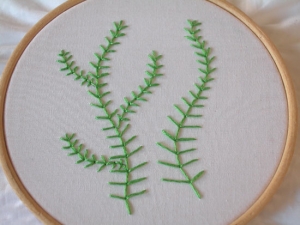
The fern stitch is a simple technique to form sprays or leaf veinings. It includes three straight stitches, of equal length, worked in different directions from one central point.
Double Lazy Daisy Stitch
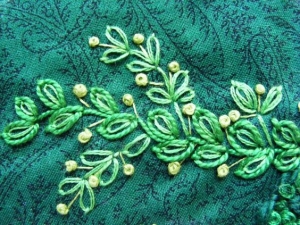
A double lazy daisy stitch, or double lazy stitch, is in fact a double or triple ring of lazy daisy stitches. After working a ring of lazy daisy stitches, another ring in another shade or colour is embroidered around it, and another ring may be worked around the second ring.
Guimarães Embroidery
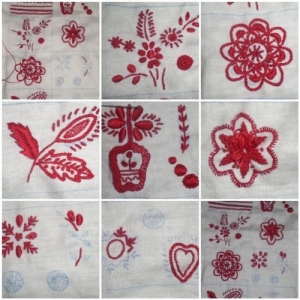
Guimarães embroidery is a form of decorative needlework that derives from Guimarães in northern Portugal. It is known locally as Bordado de Guimarães. There are written references to the production of embroidery in this region dating back to the tenth century.
Sardinian Knotted Embroidery
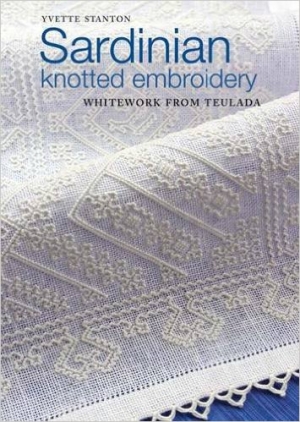
Sardinian knotted embroidery is a form of whitework from the town of Teulada, in southern Sardinia. Teulada embroidery is locally called Punt ‘e Nù (‘knotted stitches’) and is a form of counted thread work. The main stitch is the coral stitch, which is worked in geometric patterns of varying degrees of complexity. The designs are usually worked in diagonal lines, working from left to right.
Mansudae Art Studio

The Mansudae Art Studio complex in Pyongyang, North Korea, is perhaps the largest 'art' production complex in the world. According to its official webside, run by the Italian firm of Pier Luigi Cecioni, the North Korean firm employs some 4000 people and covers a surface of some 120000 square metres. It produces a wide range of objects, including ceramics, (huge) bronze statues, oil paintings, and embroideries.
Ladder Stitch
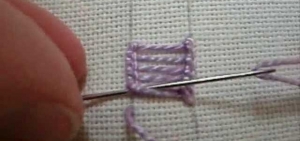
The ladder stitch is a technique that forms a tight braid on either side of a 'ladder'. It is a technique used to create a decorative border. The name ladder stitch is sometimes used for the open chain stitch or the ladder hem stitch. Also known as blind stitch, hidden stitch, or slip stitch.
Tagliente, Giovanni Antonio (c. 1465-1528)
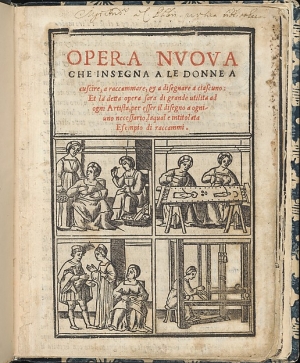
Giovanni Antonio Tagliente, from Venice, Italy (c. 1465-1528?) was an author, calligrapher, printer and publisher, who in 1527 published a pattern book (Opera Nuova ... Intitolata essempio di recammi), which also included descriptions of how to transfer a pattern to a textile ground material.
Tambour Hook and Ari Hook
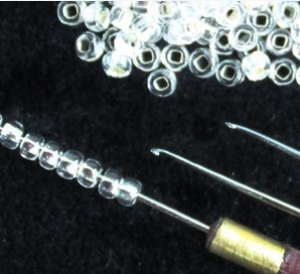
In some publications no difference is made between a tambour hook and an ari hook, especially as these hooks are only slightly different in shape and both are used for similar types of embroidery as well as beading. Both hooks, for example, are used in a similar way for chain stitch embroidery.
Embroidery and postage stamps
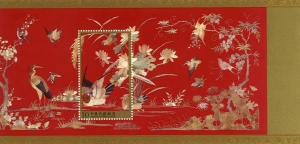
Depictions of famous people, moments of historical significance, well-known buildings and land marks often appear on postage stamps from around the world. Considerably rarer are stamps that depict textiles, especially embroidery. Some of these stamps are part of a series about folk art in general, others are deliberately dedicated to the subject.