

John Ruskin Prize 2014

The John Ruskin Prize was first announced in 2012 and is named after the nineteenth century art critic, John Ruskin. It is awarded each year to an artist (professional or amateur), who has produced a work on the theme of “Recording Britain Now: Fresh, contemporary visions of the UK's urban, rural or social environment.“
Roman Cross
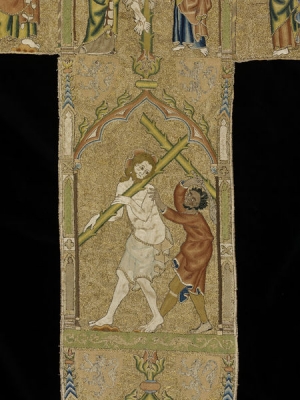
A basic cross is a geometric design made up of two intersecting lines. In the Christian tradition a cross was used to crucify Jesus Christ, as told in the New Testament. There are many different forms of crosses that used in the Christian Church, depending on its denomination, to commemorate the crucifixion of Christ.
Ribbon
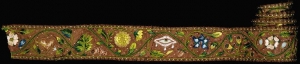
A ribbon is a narrow, flat and flexible woven band that may range in appearance from simple and monochrome to being decorated with multi-coloured and repetitive (embroidered or woven) patterns. Ribbons may also be made out of velvet, satin or some other complex weave. They are usually between 0.3 and 10 cm in width.
Point de ....
In Europe, until the early twentieth century, French terminology for lace and embroidery was very wide-spread.
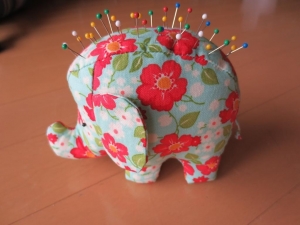
Pin
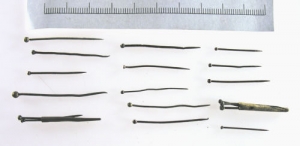
A sewing pin (Late Old English: pinn) is a small piece of pointed bone, metal, thorn, wood, etc., used to fasten or hold together parts of a structure. By the medieval period, in Europe, it had become a slender piece of wire (usually brass or iron) with a sharp tapered point and a flattened round head.
Piece (verb)
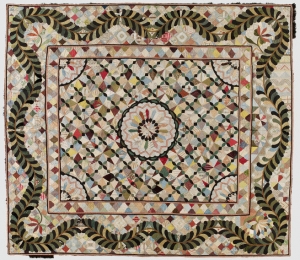
According to the Shorter Oxford English Dictionary, the verb 'to piece' means: 'to mend, make whole or complete by adding a piece or pieces; to patch.' The verb has also taken on a related meaning in the terms 'piecework' or 'pieced patchwork', which is a form of patchwork that is made by sewing together small, geometric shapes cut out of stiffish paper or card, which are covered in cloth.
Aniline
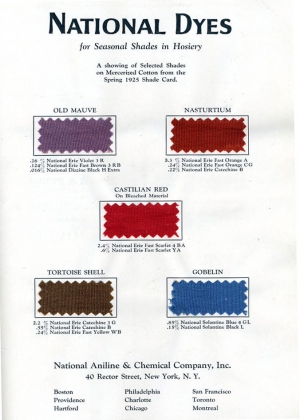
Aniline is a chemical compound discovered in mid-nineteenth century Europe, which forms the basis for the modern synthetic dye industry. Aniline dyes are known for their wide range of bright colours that do not fade (unlike many natural dyes).
Nambu Hishi Zashi
The term nambu hishi zashi refers to a stitched lozenge pattern that is characteristic for the embroidery from the Nambu district, Japan.