

Scottish Diaspora Tapestry
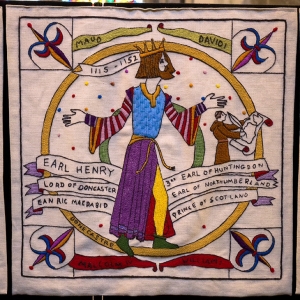
The Scottish diaspora tapestry is a commemorative embroidery and a form of community art work organised by Baron Gordon Prestoungrange. The tapestry was designed on the theme of the emigration of Scots around the world. Communities and institutions (such as schools) in 25 countries where Scots have settled worked on the panels.
Sicilian Lace
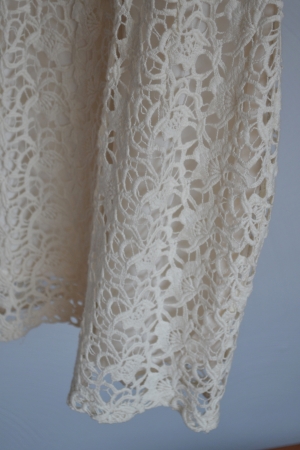
Sicilian lace is the term for various types of embroidered lace, notably buratto embroidery, drawn thread work and darned net, made in Sicily from the sixteenth century onwards. Sicilian lace was used for both secular and religious purposes. Some forms of Sicilian lace were embroidered with coloured silks, notably, bluish green, rose pink and canary yellow.
Sam Cloth
Sam cloth is an American term for a needlework sampler, and more specifically a beginner’s practice piece in sewing letters of the alphabet.
Woollies
See sailor's woolworks. Also written woolies.
Sailor's Woolworks
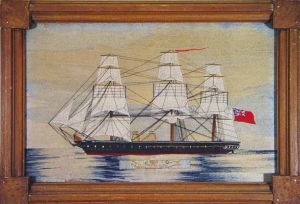
Sailor's woolworks is a general term for decorative needlework pictures that in most cases show a specific ship or a generalised (sailing) ship. They have the nickname 'woolies'. Some of the sailor's woolworks are embroidered, others are made from appliqué cloth. Seamen produced such pictures from about the 1830's until the First World War (1914-1918).
Ruffini, Louis (c. 1760-1804)
Louis Ruffini (c. 1760-1804; also written Luigi Ruffini or Luigi Ruffin) was an Italian entrepreneur who with his family settled in Edinburgh in 1782.
Rice Embroidery
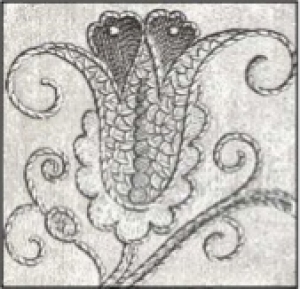
Rice embroidery is a type of whitework, which extensively uses rice stitch or point de riz. This is a free-style stitch that resembles individual grains of rice. It was popular in late nineteenth century Western Europe and North America.
Rhodesian Tapestry
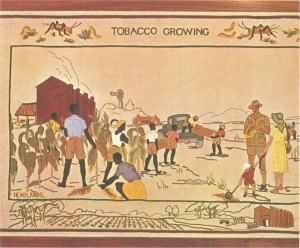
The Rhodesian tapestry is a series of embroidered panels that depict various elements of Rhodesian (Zimbabwean) history. The original plans for the tapestry date back to 1946, when Lady Kate Tait, wife of the then (ex-) Governor of Southern Rhodesia, Sir Campbell Tait, suggested that an embroidery should be made that depicted the “cardinal events in Rhodesian history on the lines of the Bayeux Tapestry” (Ransford 1971:4).
Rhodes Embroidery

Rhodes embroidery is the name for a form of pulled thread work that was popular in northwestern Europe in the early twentieth century. Rhodes embroidery, which is often classed as a form of embroidered lace, was apparently based on traditional drawn thread work from the Greek island of Rhodes.
Reverse Appliqué
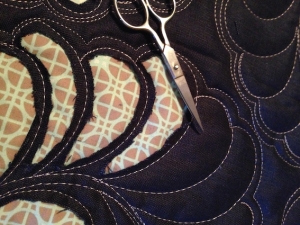
Reverse appliqué is a needlework technique whereby several layers of cloth are placed on top of each other and shapes are cut out in layers of decreasing size. Some of the most famous reverse appliqués are the molas from Panama, worked by Kuna Indian women.