


Redwork
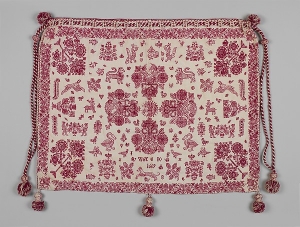
Redwork is a form of counted thread embroidery that uses a red thread (usually silk or cotton) on a white cloth background. It is usually carried out in a double running stitch (Holbein stitch), but other stitches are possible. The patterns produced tend to be geometrical or stylised figurative and floral forms.
Quaker Tapestry

The Quaker tapestry is a commemorative embroidery that illustrates the history of Quakerism (a Christian, non-Conformist religious group; also known as the Society of Friends). The idea for the Tapestry came from Anne Wynn-Wilson, who was influenced by the Bayeux tapestry.
Quentel, Peter (d. 1546)
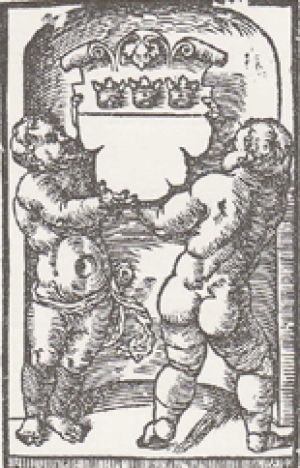
Peter Quentel (also known as Pierre de Quinty) was a printer from Cologne (Germany) in the early sixteenth century. He was the son of Heinrich Quentel (d. 1501), a printer whose books include a range of Lutheran tracts and treatises. His son, Peter Quentel, printed at least one book on embroidery and lace designs. He is sometimes listed as Pierre de Quinty and described as a French Protestant.
Quaker Lace
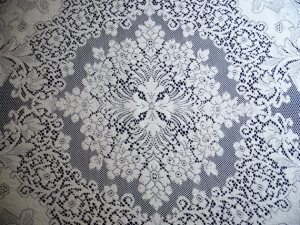
Quaker lace is an American term used for darned netting or darned net.
Prick and Pounce
See pouncing.
Pouncing
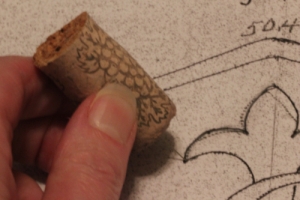
Pouncing is a technique whereby the outline of a pattern is pricked on paper or card. This is done with a pin. Afterwards the pricked page is attached to a ground material and then rubbing soot or ground charcoal (on a light ground cloth) or chalk (on a dark ground cloth) is spread over the pinned paper and forced through the pin holes so that when the page is removed, a series of dots are left in place, facilitating the embroidering.
Plymouth Congregational Church Tapestry
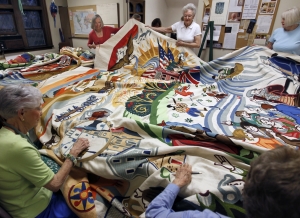
The Plymouth Congregational Church tapestry (Minneapolis, USA) is a commemorative embroidery based on the four seasons. The tapestry was commissioned by Mary and Paul Carson (he was then minister of the Congregational Church) and designed by the British illustrator, Pauline Baynes. The embroidery was started in 1971 and took about forty years for the four panels to be finished.
The Plimoth Jacket
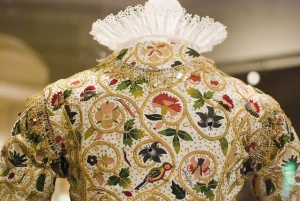
The Plimoth jacket is a recreated seventeenth century embroidered woman’s jacket. It was modelled on two such jackets now in the Victoria & Albert Museum, London. The jacket reflects fashionable items of clothing that were popular in the early seventeenth century and worn by noble and wealthy women.
Punto Tirato
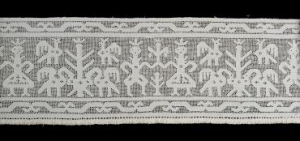
Punto Tirato is an Italian term for a form of drawn thread work, whereby one set of threads (usually the wefts) is removed. It was often used to create a more decorative hem.