

Dress with Shisha Work (India)
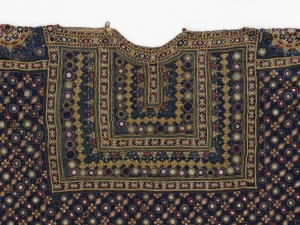
The Victoria and Albert Museum in London houses a dress measuring 101 x 111 cm. It was made in the late nineteenth century, and consists of a silk satin ground material with silk thread embroidery and shisha work. The embroidery was worked in buttonhole, chain stitch and interlacing stitch. Curatorial information suggests that the dress originates from the Muslim Memon or merchant community in Banni, Kutch.
Mid-Eighteenth Century Waistcoat (India)
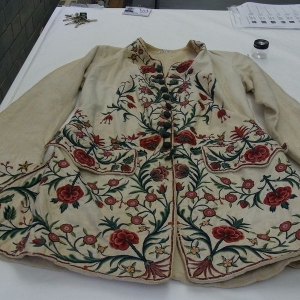
The Victoria and Albert Museum in London houses a waistcoat measuring 76.2 x 38.1 cm. It was made in the mid-eighteenth century in India, perhaps for the European market, and consists of a cotton ground material with woollen thread embroidery.
Dress Fabric, Gujarat (India)
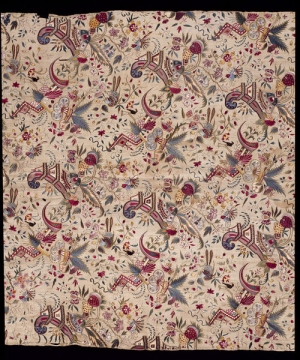
The Victoria and Albert Museum in London houses a piece of dress fabric measuring 220 x 106 cm. It was probably made in Gujarat, western India, in the early eighteenth century, and consists of a cotton ground material with silk thread embroidery. The designs include birds, flowers, fruit, but also architectural motifs and are worked in chain stitch. The designs are repeated twice for every width.
Simple Knot Stitch
See seed stitch.
Rice Grain Stitch
See seed stitch.
Hidden Stitch
See ladder stitch.
Slip Stitch
See ladder stitch.
Tristan Embroideries
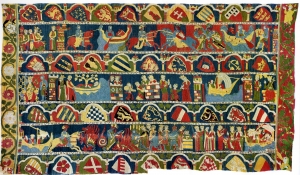
The convent of Wienhausen (Germany) houses three embroideries that illustrate the medieval legend of Tristan and Iseuld (Isolde). The oldest of the three dates to c. AD 1300. It measures 2.33 x 4.04 cm. It is embroidered in wool on a linen ground material, using the kloster stitch.
Charles I and Charles II
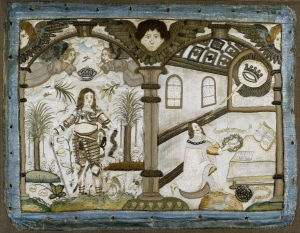
The Victoria and Albert Museum in London houses a remarkable embroidered picture, representing Charles I just before his execution on 30 January 1649, with his son, Charles II, standing to the left. The embroidery is worked in silk and metallic thread, with seed pearls, on a white satin ground. It measures 36.5 x 47.3 cm.
Maria of Tver's Veronica's veil embroidery
Reputedly the oldest extant example of Russian ecclesiastical embroidery is the so-called veil or shroud of Grand Princess Maria of Tver, from c. AD 1400.