

Tent Lining (India)
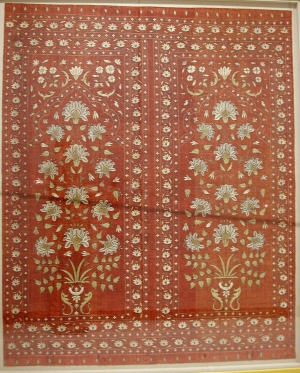
The Metropolitan Museum of Art in New York houses a quilted fragment of tent lining from eighteenth century India. It has a cotton back material and silk thread embroidery. It measures 170 x 142 cm. The embroidery shows the characteristic Mughal motif of a flowering plant in an arched niche.
Decorative pendant (China)
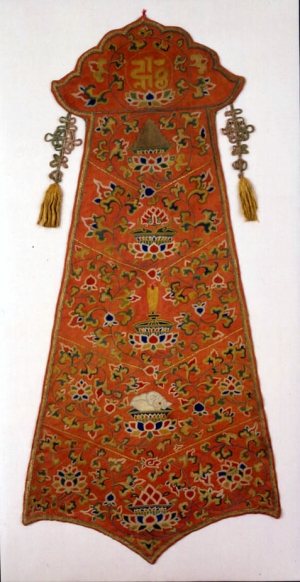
The Metropolitan Museum of Art in New York houses a decorative pendant made of silk and metal thread embroidery on a silk satin back material. It measures 65 x 30.5 cm and has been dated to the early fifteenth century, in the Ming dynasty (1368-1644).
Buddhist guardian king (China)
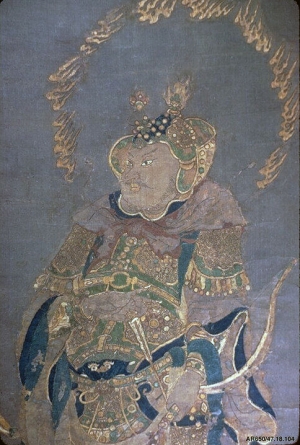
The Metropolitan Museum of Art in New York houses a hanging scroll with silk appliqué and embroidery on a silk back material. It measures 96 x 47 cm and has been dated to the Ming dynasty (1368-1644).
Sacrifice of Polyxena
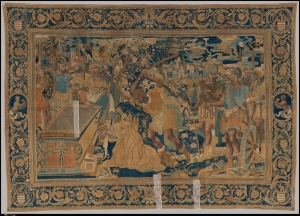
'The sacrifice of Polyxena' is the name given to a large hanging now in the Metropolitan Museum of Art, New York. It probably dates to the late sixteenth century, and was likely made in China (Macao?). It measures 381 x 523 cm and is made of a cotton ground material with silk and gilt paper wrapped embroidery thread (Japanese thread) and with painted decorations.
Prophecy of Calchas (China)
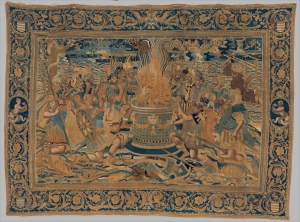
'The prophecy of Calchas' is the name given to a large hanging now in the Metropolitan Museum of Art, New York. It probably dates to the late sixteenth century, and was likely made in China (Macao?). It measures 375 x 498 cm and is made of a cotton ground material with silk and gilt paper wrapped embroidery thread (Japanese thread) and with painted decorations.
Abduction of Helen (China)

'The abduction of Helen' is the name given to a large hanging now in the Metropolitan Museum of Art, New York. It probably dates to the early seventeenth century, and was likely made in China (Macau?). It measures 363 x 480 cm and is made of a cotton ground material with silk and gilt-paper wrapped embroidery thread (Japanese thread) and with painted decorations.
Valance made in China
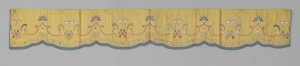
The Rijksmuseum in Amsterdam houses an early eighteenth century (high) valance (Dutch: lambrekijn), made of yellow silk cloth that was probably made and embroidered in China. The motifs include flowers and butterflies.
Embroidered quilt (India)

The Rijksmuseum in Amsterdam houses a nineteenth century quilt from India, made of cotton and embroidered with floral motifs, worked with a hook (ari) and chain stitch, using silk thread, and filled with cotton. The cloth measures 69.5 x 61.5 cm. The collection of the Rijksmuseum also has a series of comparable quilts.
Votive panel from China
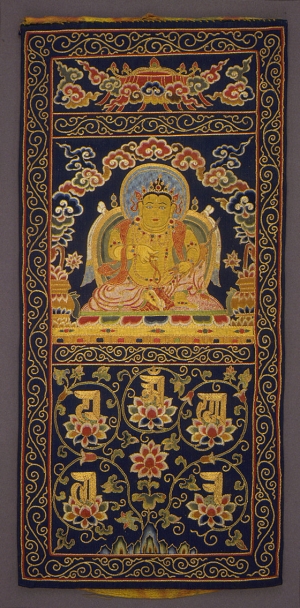
The Los Angeles County Museum of Art houses a votive panel from China, which dates to the early fifteenth century. It measures 40 x 18 cm. It is made of silk with silk and metal thread embroidery.
Ritual diadem (China)
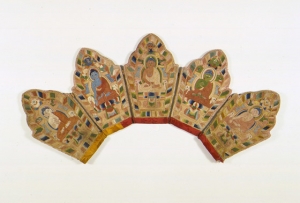
The Los Angeles County Museum of Art houses a ritual diadem (guan) from China, which dates to the late fifteenth century. It is made of gilded paper with silk embroidery. It measures 29 x 58 cm.