

The Lakai Uzbeks moved from Central Asia in the north and settled in the Kunduz area of northern Afghanistan, after the Bolshevik revolution in Russia. They are particularly known for their embroidery. Their work is characterised by the use of the cross stitch, and the multi-coloured geometric motifs carried out on bags, belts and bands.

The American Folk Art Museum in New York was established in 1961 and is dedicated to the artistic expressions of self-taught American artists, from the eighteenth century until the present day. The Museum sets up exhibitions, organises educative projects and runs a publication programme. The collection includes some 8,000 items (2016), among which textiles (quilts, samplers), paintings, three-dimensional objects, photographs, etc.
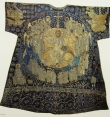
The so-called Dalmatic of Charlemagne is held in the Treasury Museum of the Vatican Basilica. However, it is neither originally a dalmatic, nor was it ever worn by Charlemagne. It is probably an imperial garment (a sakkos), made of silk, from the Byzantine empire, and perhaps of an eleventh century date (other scholars suggest a fourteenth century date).
The Late Latin term auriphrygium derives from aurum ('gold') and Phrygius ('Phrygian').
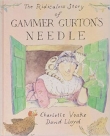
Gammer Gurton's Needle is the title of an anonymous rustic and poetic drama that was written, allegedly, in 1533, and performed at Christ's College, Cambridge, in 1566 or 1567. It is a comedy in which a lost needle plays the major part. Its full title is A Ryght Pithy, Pleasaunt and Merie Comedie: Intytuled Gammer Gurtons Nedl. It was accredited in the past to Bishop John Still, but this association has since been refuted.

Dame Elizabeth Wardle was an embroideress from Staffordshire. She married Thomas Wardle (1831-1909) in Leek (Staffordshire) in 1857. Her brother George Young Wardle worked for William Morris, who lived and worked in Leek between 1875 and 1878.

The Leek Embroidery Society and the associated Leek School of Embroidery were founded in 1879/1880 by the embroideress Elizabeth Wardle and her husband, Thomas Wardle. The Society, initially called the Leek Sewing Circle, produced both domestic and ecclesiastical embroidery work, that was granted prestigious awards for its fineness and high quality. Most of the work, including the dying, took place in Leek, Staffordshire.

A passage from a poem by William Augustus P. Hewett, called 'The Christian muse's birthplace, and filial honour's tribute, a poem', from 1848, refers to the difficult life of the lace makers in England, who were confronted by the marketing of much cheaper machine-made products.

The Turkmen speak a form of Western Ghuz (Oghuz) Turkic, closely related to the languge spoken in modern Turkey, and which now includes many Arabic and Farsi words. At the end of the nineteenth century, the Turkmen region was divided among Afghanistan, Iran and the former Soviet Union. At the end of the twentieth century, the independent republic of Turkmenistan was founded.

Gul-i pirahan ('flower of the shirt') is the term for an ornamental roundel on Pashtun garments and other items. They are generally made of felt and covered with symbols and objects of good luck and fertility, such as coloured beads, cowrie shells and metal discs. These roundels are usually applied in pairs and stitched to the upper part of women’s dresses, bags and animal trappings.
More...
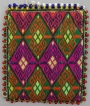
The Hazaras from central Afghanistan are known for working embroidery on cotton or silk material enlivened by very fine lines of cross or herringbone stitch. Hazara embroidery tends to be a form of counted thread work rather than free style embroidery. It is generally very fine and precize.

Louisa Bellinger (1900-1968) was an American curator and writer about textiles. She was the daughter of Hiram Pauling Bellinger (1865-1930) and Elizabeth Dwight Raymond (1868-1963). Her brother was Alfred Raymond Bellinger (1883-1978), Dean of the Classics Department of Yale University and a well-known Classicist and Byzantine scholar specialising in Byzantine period coins.

A bertha is a collar made of lace or another thin fabric. It is generally flat and round, covering the low neckline of a dress, and accentuating a woman's shoulders. It was particularly popular in the nineteenth century, but bertha-like garments were also worn in the seventeenth century and are still being worn, as for instance with bridal dresses.

The Oaxaca Textile Museum (Museo Textil de Oaxaca) is a museum and educational centre in Oaxaca, Mexico, dedicated to textiles, including beadwork and embroideries. The Museum opened in 2006 after the donation of six large, private collections, each consisting of several hundred pieces. The overall collection mainly consists of Mexican and Central American textiles.