
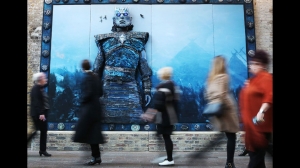
In 2015/6 various embroidery groups across the United Kingdom came together to create a commemorative embroidery dedicated to the so-called Massacre of Hardhome. It was commissioned by HBO Home Entertainment TV Network in order to celebrate the launch of the Game of Thrones Series 5 (Blue Ray and dvd box set).

Les brodeuses ('The embroiderers') is the name generally given to any of a series of drawings and lithographs by the French painter and lithographer, Ignace Henri Jean Théodore Fantin-Latour (1835-1904). They are now spread all over the world.
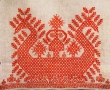
Embroidery has for centuries played an important role in Russian daily life. The mainly linen garments were often decorated with embroidered hems, and the towels were often skillfully embellished. Embroideries were also often included in dowries, reflecting the social position of the bride's family, but also the skills of the bride.
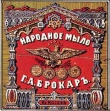
Henri Brocard (Genrich Brokar; 1836-1900) was a Russian-French businessman and philanthropist, who in the late nineteenth century set up the Moscow firm of perfume and soap production, Brokar and Co. In order to attract customers, especially for his soaps, he included a free chart of a cross-stitch design with his products.
A filament is the term generally used for a continuous fibre, such as that of silk. WV


The Roman Catholic cathedral of Bamberg, Germany (Bamberger Dom), is dedicated to St. Peter and St. George. The building of the cathedral was commissioned in AD 1004 by Heinrich II (973-1024) and was completed in the thirteenth century. There are stone statues of St. Heinrich II and his wife, St. Kunigunde, in the entrance porch.

The Sternenmantel of Heinrich II is one of the oldest surviving European embroidered copes. Heinrich II (973-1024) had many titles and positions. He was the Duke of Bavaria (from 995), King of Germany (1002), King of Italy (1004) and eventually he became the Holy Roman Emperor (1014). He was married in 999 to Kunigunde (Cunigunde) of Luxembourg, who later became known as St. Kunigunde.

Leather falcon hoods are used to cover the heads of falcons when they are being trained to hunt (see falconry) in the company of humans and to keep them focussed during a hunt. They are worn to help the bird acclimatise to human beings and to keep the bird in a calm state. It is said that the use of hoods was introduced into Europe, from the Middle East, during the Crusades.
More...

The so-called Wodehouse falcon hood is a leather cap embroidered with silk and metallic threads, now housed in the Museum of Fine Arts, Boston. It is believed to be French in origin and dates to the seventeenth or possibly eighteenth century.
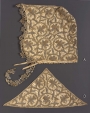
A woman's coif and forehead piece are two early seventeenth century woman’s embroidered items from England, housed in the Boston Museum of Fine Arts, USA (acc. nos. 43.244a-b). The headpiece was worn over the head and forehead and covered by the coif or closely fitting cap.

The full title of this institute is 'The Clothworkers’ Centre for the Study and Conservation of Textiles and Fashion'. It is located at Blythe House in West London. The Centre was opened on 8th October 2013 by the Victoria and Albert Museum, London and is financially supported by the Clothworkers Foundation, London.

Shonai sashiko is a traditional technique from the Shonai region, Yamagata, in the northwest of Japan. It was originally used to combine two or more layers of hemp or cotton cloth, and is characterised by straight lines that cross and recross each other, and made with running stitch. Formerly a stitching technique, it is now more of an embroidery technique used for one layer of cloth.