
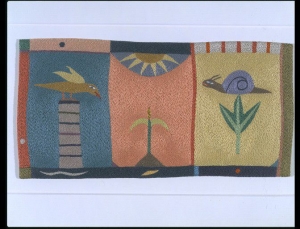
Jane Poulton (1957) is an English embroiderer who makes small items decorated with hand and machine embroidery. There is an example of her machine embroidery, now in the Victoria and Albert Museum (acc. no. T.162-1990). The design is called 'It's only me' and is added to a purse.

Jane Poulton (1957) is a contemporary British artist who uses machine and hand embroidery to decorate small items, such as purses. She is well-known for her embroidered pictures of figurative subjects, which often feature small animals and birds.

Cuvette is a general term for a particular type of round sequin that has raised, faceted sides. The word comes from the French diminutive for cuve, meaning an ornamental, shallow dish for holding water. Cuvettes used for decorative needlework may be made of glass, metal, plastic, etc.
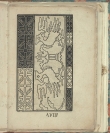
Giovanni Andrea Vavassore (fl. 1530-1573) was a Venetian who was active in the mid-sixteenth century. Vavassore (who was also known as Guadagnino) produced at least one pattern book for embroidery, including Modano (Tuscan filet) and for drawn work. He is particularly known for his Corona di Racammi ('Crown of Embroidery'), which was published in 1530 and reprinted two years later.
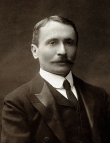
Sir Marc Aurel Stein (1862-1943) was a British/Hungarian archaeologist, ethnographer, geographer and linguist, who wrote many books about his expeditions and discoveries in India, Iran and Central Asia. He died in 1943 in Afghanistan and lies buried in the Christian cemetery of Kabul.
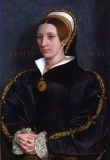
A seventeenth century portrait of a Tudor lady after Hans Holbein the Younger (1497-1543) has been variously described as that of Catherine Howard (1521-1542; fifth wife of Henry VIII of England) or possibly of Elizabeth Seymour (1518-1568; sister of Jane Seymour, the second wife of Henry VIII).
A guard is a sixteenth and seventeenth century term for a ribbon or band of a rich material that was used as a border on clothing in order to conceal seams and hems.

A palampore is type of bed cover or wall hanging that was made in India for the export market, especially Britain and The Netherlands, during the eighteenth and early nineteenth centuries.

The Philadelphia Museum of Art (USA) houses an unassembled coif that dates to the late sixteenth century. It is made from a length of linen that has been embroidered with silk and gilt thread. In order to assemble the coif it would have been folded in half vertically, and then stitched around the edges, but leaving the front edges unstitched (open). The coif would have been secured with a drawstring along the bottom edge.

A coif is a close-fitting cap that covers the top, back and sides of the head. It was worn by both men and women during the medieval period and later in Northern Europe. The word coif derives from the Old French word coife (modern coiffe) meaning a headdress. It is also related to the late Latin cuphea, cofea, meaning a helmet. The headdress and the word are probably related to the Anglo-Saxon cuffia/cuffie, known from the tenth century.
More...
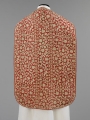
The Victoria and Albert Museum (London) houses a chasuble (acc. no. 743-1870) dating from the late seventeenth century, which is decorated with (Venetian) raised needle lace mounted on a red silk ground (this may be a Victorian mount). The floral motifs are separated by narrow bands with flower heads. All of the lace is worked in a linen thread.

Fine and Fashionable: Lace from the Blackborne Collection was an exhibition held at the Bowes Museum (Barnard Castle, Co. Durham, England) between September 2006 and April 2007. The exhibition included over 200 items of early bobbin and needle lace that were donated to the Museum by descendents of Anthony and Arthur Blackborne, London-based dealers in lace in the nineteenth and early twentieth centuries.

In the Blackborne collection of the Bowes Museum (UK), there is a needle lace collar (79 x 21.5 cm), which is believed to date to the 1630's. It may even have been worn by the British king, Charles I (1600-1649). During the late nineteenth century the collar was the property of the London based lace dealers, Blackborne & Co.

A. Blackborne & Company was the trade name of father Anthony (1824-1878) and son Arthur Blackborne (1856-1952), lace dealers. They began work around 1850 and operated their business from 35 South Audley Street, London (UK), near the fashionable shopping areas of Bond Street and Oxford Street. They held a Royal Warrant from 1863 to 1912 from Alexandra, Princess of Wales and later the Queen.