

Ann Macbeth (1875-1948) was a British author, embroideress and head of the Embroidery department at the Glasgow School of Art, from 1908 to 1921. She was the daughter of the Scottish engineer, Norman Macbeth, and Annie MacNicol.

Cissie Wilcox’s embroidered panel is a small, embroidered panel made by a suffragette prisoner called Cissie Wilcox while she was in Holloway Jail in 1911. The white silk panel is 14.0 x 8.5 cm in size and embroidered in the suffragette colours of green and purple.
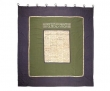
The WSPU Holloway Banner is an embroidered banner that bears the names of eighty suffragettes who were on hunger strike in Holloway Jail, London, in 1909-1910. The banner was made from a quilt designed by Ann Macbeth. It was donated to the Women’s Social and Political Union (WSPU; Scottish branch) in 1910. The banner is now in the Museum of London collection (acc. no. Z6092).
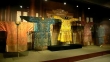
The China National Silk Museum was opened in 1992 in the city of Hangzhou (Zhejiang Province), China. It has eight permanent galleries, or halls, that cover all aspects of the history of silk production and trade in China.
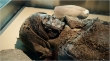
The Xinjiang Autonomous Region Museum in Urumqi (also known as the Xinjiang Regional Museum) houses some 50,000 objects found in China’s most western province. The most famous objects on display are the desert Tarim Basin mummies, some of which are 3,800 years old.
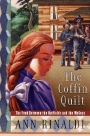
The Coffin Quilt is a children’s book by Ann Rinaldi (1934), which was first published in 1991. The book is set in West Virginia/Kentucky (USA) and relates the story of the Hatfield-McCoy feud that actually took place in the late nineteenth century.

Godey's Magazine was an American women's magazine published in the nineteenth century. Godey's Magazine was first published in 1830 as The Lady's Book. In about 1840 it became known as Godey’s Lady’s Book. Later it became simply known as 'Godey's Magazine'. Godey’s Magazine ceased publication in 1898 and was absorbed by another magazine called The Puritan.
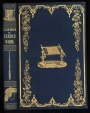
Frances S. Lambert was a mid-nineteenth century British embroideress and author of several influential books about embroidery. Her books were published in both Britain and North America.

A machine that could imitate the appearance of hand stitches is the Hand-Embroidery Machine, which was invented in 1828 by Josué Heilmann (1796-1848) in Mulhouse, France. In 1835, technical drawings of his machine were published and over the following decades various companies, especially in France, Germany and Switzerland, and later around the world, developed variations on Heilmann’s machine.
More...
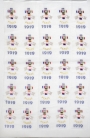
Decorative postcards with a short text were popular in Europe from the early 1900's until the 1950's. Many of these were made in France. The cards include a wide variety of designs and messages worked in floss silk in various colours. Some ten million embroidered cards were produced. Woven silk postcards (especially by the Nayret Frères, St. Etienne, France) were also being made, but these were not as popular.
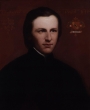
The Ladies Ecclesiastical Embroidery Society was founded in 1854 by Agnes Blencowe. The stated aim of the society was to “supply altar cloths of strictly ecclesiastical design either by reproducing ancient examples or by working under the supervision of a competent architect.” The Ladies Ecclesiastical Embroidery Society was also sometimes known as the Society for the Advancement of Ecclesiastical Embroidery.

The National Folk Museum of Korea was opened in 1946 as the National Museum of Anthropology with the stated aim to investigate and study Korean folk life and to acquire and preserve artefacts relating to Korean cultural life. It changed its name to the National Folk Museum of Korea in 1975.
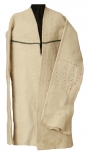
The Textile Research Centre (TRC) in Leiden keeps a traditional felt coat from southern Afghanistan (TRC 2010.0087). This type of garment is called a kusai and is illustrated in Mountstuart Elphinsone's Account of the Kindom of Caubul.., which was first published in 1815. This type of coat is still worn by Pashtun nomads (Kuchis) in the region.