
According to Sophia Caulfeild and Blanche Saward (1882), 'rond bosse' is a term for a raised embroidery.

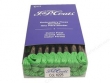
Six-strand(ed) embroidery floss is the American term for a type of embroidery thread that is produced, among others, by the company of J. & P. Coats. The term six strand(ed) embroidery floss is known on the British market as 'six-stranded embroidery thread' (or occasionally as a 'six-stranded mercerised cotton thread'). The floss/thread is used for a wide range of embroidery forms.
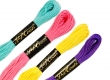
J. & P. Coats is an originally Scottish fine-thread company that was founded by a weaver called James Coats (1774-1857) and his brother Patrick, in Paisley, near Glasgow. The story of Coats is complicated, as it involves British as well as North American based companies, run by various members of the Coats family. It was also closely involved in the activities of the rival Scottish company of Clark.

The Clark Thread Company was originally a Scottish firm that manufactured embroidery and sewing threads for many years. The company was established in the 1750's by two brothers, James and Patrick Clark. The story of this company is complicated, as it involves British as well as North American based companies run by various members of the Clark family.

Sir George Watt (1851-1930) was a Scottish born botanist who provided very detailed information about Indian plants, as well as the Indian industries that used the plants (and other materials). Sir George Watt was born in Aberdeen and then went to the Universities of Aberdeen and Glasgow. He graduated as a doctor of medicine. In 1873-4 he became Professor of Botany at Calcutta University.

In the nineteenth and twentieth centuries, the northeastern Indian city of Lucknow was well-known for the production of a wide range of metal threads.
Lais is a nineteenth and early twentieth century Indian (Hindu) term for a form of woven braid.

In various (English language) books about Indian textiles, the terms 'lace' and ‘lace makers' are associated with the production of woven braids and trimmings made from metal thread. These braids and trimmings are collectively known by the Hindu word ‘gota.’ They were and still are produced in Lucknow and other Indian cities.
More...

A detached overcast stitch is a raised stitch that is created using a foundation line of stem stitches, which is then hidden with small overcast stitches.


A trimming is a strip of cloth, lace or band, etc., in which one longitudinal edge (head, header) is plain and runs straight, while the other longitudinal edge (foot, footer) is normally wavy or scalloped in some manner, or provided with tassels etc. The foot is the edge that is normally left showing, so that the wearer and viewer can ‘admire’ its appearance. Not to be confused with trimming (1).

A braid is a length of semi-flexible, flattish, decorative (interlaced, knotted, woven) band that may be made of two or more different types of thread. They are often, but not necessarily, made from types of metallic thread and may include additional items such as beads. Braids are usually between 1.0 - 8.0 cm in width.