

The company of W & J Knox was a linen thread company based in Kilbirnie, Ayrshire, Scotland, established in 1778. They advertised themselves as a Linen Thread Manufacture Works and Fishing Net Manufactory. It eventually became a Scottish based company with outlets and, later, mills in Canada (especially the Vancouver region) and the USA. The initials stand for William Knox (b. 1802- ?) and James Knox (b. 1807).
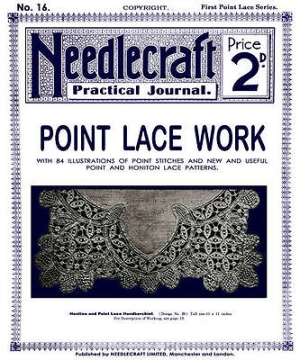
The Needlecraft Practical Journal is a British journal dedicated to the teaching of needlework, and of embroidery in particular. The journal was set up by the Manchester School of Embroidery and the British transfers and traced needlework manufacturer, Briggs & Co, Manchester.
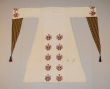
The Qalamoun region lies just to the north of Damascus (Syria) and stretches nearly as far as the city of Homs. The traditional Qalamoun outfit for women includes a pair of decorated trousers and a decorated dress.
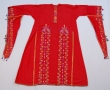
The village of Quteife lies in the Qalamoun region of western Syria. It was known for its distinctive red festive dresses with some embroidery on the neck opening, skirt front and along the edges of its large, triangular sleeves. Perhaps because of their colour they have comparatively little embroidery, in comparison to other Syrian embroidered garments.
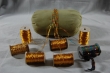
Hand-woven, metal thread braids are traditionally produced by women in Oman. These braids are applied to both women and girls’ garments, especially their tunics and trousers. The various regions of Oman use different types of braids. The braids are hand woven on a cushion comparable to the lace cushions used for making Honiton bobbin lace.
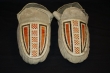
Moccasins are a form of footwear, consisting of sole and sides made from one piece of leather and stitched together at the top. The sole is normally soft and flexible. Sometimes a vamp (upper part of the footwear) is added from a separate piece of material. Moccasins can just cover the foot or reach up as far as the calf of the wearer.

Indian hemp (Apocynum cannabinum) is a perennial plant that can be found throughout much of North America. It is a member of the plant species cannabinum, which also includes hemp. It was used by some northeastern Indian groups as a source of a short plant fibre.

Many of the Eastern Woodlands and Plains Indians of North America, such as the Cree and Huran, used beading and quillwork, as well as moose hair embroidery and tassels, to decorate their garments and footwear. The example illustrated here is a sleeve cuff made from animal hide (probably buckskin), which has been decorated with porcupine quill work, tassels and imported glass beads.
Horse hair coiled work is a decorative applied technique used by Athapaskan-speaking people and other Indian tribes who lived to the west of the Great Lakes of North America.

Moose hair tassels were used by some Eastern Woodlands and Plains Indians of North America in order to decorate their garments and footwear.
More...

Moose hair false embroidery is a weaving technique often used by the Northeast Indians of North America to decorate objects such as pouches or straps. The technique is called ‘false embroidery’, because the moose hair is not applied to the finished woven item. Instead it is used as part of the weaving process. This technique was especially popular among the Huron and Iroquois peoples.
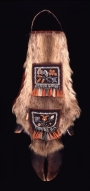
Moose hair couched embroidery is a technique that originated among the indigenous populations of the northern parts of North America. It was practised across the entire territory where moose hair was used for decorative work, although it was most commonly used by the Woodlands Indians in the northeastern part of the North American continent.

Hair from a North American animal, the moose, has traditionally been used as a textile fibre and thread. In North America, moose hair was particularly used in the northeast of the continent. Moose are known as elk in Eurasia and have the species name of Alces alces. It is the largest member of the deer family.