

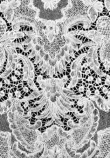
Brussels lace is the name given to various forms of lace produced over the centuries in and around Brussels. More specifically, it is applied to various forms of non-continuous bobbin lace: the bobbin-lace patterns are made separately from the net (réseau).
Lace can be divided into various groups on the basis of its production method. This survey focuses on the types of lace that are made with a needle and with decorative stitching, thus excluding many other types of lace, such as bobbin, knotted and looped forms. Please bear in mind that the names of the various lace types may vary and are not always universally accepted.
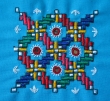
Khaarek is a form of satin stitch used for counted thread work in western India (Kutch). Khaarek embroidery is carried out by Sodha, Rajput and Meghwal communities. Geometric patterns are first outlined on a fabric and then filled in with bands of satin stitches (kharek) that are worked along the warp and weft from the front.
The Jats are a conglomeration of peoples who live in parts of Pakistan and northwestern India (Haryana, Gujarat, Kutch and Rajasthan). Traditionally they make their living by herding or farming. The diversity of the Jats means that they may be Hindus, Muslims or Sikhs. The Kutch Jats are known for their embroidery work, which comes in a diversity of forms.

The Drones Quilt Project is a USA-based quilting programme and an example of the deliberate political use of textiles and decorative needlework in particular. It began in 2013 and was started by Leah Boger, a former USA Naval officer and anti-war activist.

A podruchnik (Подручник) is a small rug or flat cushion of about 40 x 40 cm. It is used by Russian Orthodox Christians and especially Old Believer families to keep the hands and head clean while prostrating during the various prayer rituals.
Janet McDonald Davies lives in New Zealand and is a teacher of needlework, in particular quilting. She has written various books in this field. Her love of the subject and personal understanding are reflected in her humorous poetry. Below are some examples of her ´Stitching Poetry´, with many thanks for her permission to publish them. For her website, click here. GVE
More...
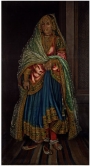
'Lady from Amritsar' is a late nineteenth century oil painting depicting a lady wearing very elaborate, embroidered garments. The painting is said to have been worked in 1880 by the English artist, Horace van Ruith (1839-1923), although there are some questions about this attribution.

The Victoria and Albert Museum in London houses a boy’s jacket that has a densely embroidered bodice and sleeves. The lower white, frilled skirt is decorated with a red band along the lower edge. The jacket is of the type worn by Rabari boys in Kutch, in the state of Gujarat in western India (see Rabari embroidery). The garment is 46 cm long, and has a width (including outstretched sleeves) of 117 cm. It is made from white cotton.

The Rabari (Rebari) are a nomadic group living mainly in the semi-desert Kutch parts of Gujarat and Rajasthan, Northwest India. Traditionally, the men followed their cattle, camels and sheep, while the Rabari women lived in permanent villages. Rabari women are famous for their embroidery skills, which are passed from mother to daughter, with the latter often spending several years embroidering clothes for their dowry.

Shrujan is a non-profit organization (NGO) founded in 1969 by Ms. Chandaben Shroff. Shroff had just visited the Kutch area in Gujarat, India, in order to help with famine relief after a severe drought. Realizing that many of local women were excellent embroiderers, she began an income-generating project with women producing up-market embroidered saris. This decision resulted in Shrujan.