

The archaeological site of Vlasac lies in the Upper Gorge of the Danube, modern Servia. Among the finds are two burials, apparently from the seventh millennium BC, that appear to include clothing embellished with applied fish teeth and shell beads.
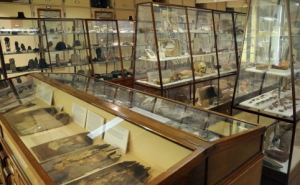
The Petrie Museum of Egyptian Archaeology, London, is more commonly known just as the Petrie Museum. It was set up as a teaching resource for the Department of Archaeology and Philology, University College London (UCL). The department and the museum were established in 1892 as a result of a bequest by the English writer and traveller, Amelia Edwards (1831-1892).
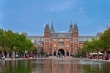
The Rijksmuseum ('National Museum') was founded in The Hague in 1800 and moved to various buildings in Amsterdam in 1808 and later. The current building in Amsterdam was opened in 1885. It houses a large collection of objects that reflect Dutch culture, from the medieval period onwards. Especially its collection of Dutch seventeenth century masters is world-famous.
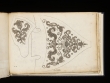
Two printed embroidery designs for respectively the vamp (upper) and tongue of a shoe are printed on one page of paper. The print dates to the early eighteenth century. The page has the inscriptions Ein schuh ('a shoe') and (plate) '42'. The intention was that two of each design would be embroidered (usually on velvet) and then sent to a shoemaker to be made up into a pair of shoes.
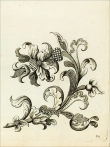
Margaretha Helm (1659-1742: née Mainberger, also known as Margaretha Helmin) was an embroidery teacher working in Nuremberg, Germany. She was also a skilled copper plate engraver, who created a series of plates of many of her embroidery designs.

Roger Vivier (1913-1998) was a French shoe designer who worked closely with a number of Parisian fashion houses. Vivier started working for Elsa Schiaparelli in the 1930's. At the time his designs were regarded by most retailers as shocking. Vivier went on to work for various fashion houses, including that of Christian Dior, in order to create one-off shoes, as well as shoes for particular fashion show collections.

In the main public hall of Münster's Rathaus (town hall), Germany, there is a large wall hanging representing peace. Although it is not actually a quilt it is closely related to the tradition of Friendship Quilts from the USA. The hanging was made in 1998 to celebrate the 350th anniversary of the Peace of Westphalia and as a direct reference to the Friedensfahne from 1648 that was made to celebrate the same event.

In the main public hall of Münster's city hall (Rathaus), Germany, there is a replica of a banner that was made to celebrate the Peace of Westphalia, which helped to officially bring to an end the Thirty Years' War in 1648. The original banner is 250 x 250 cm in size and has a mid-blue silk ground.

In the Friedenssaal of Münster's city hall (Rathaus) there is a single lady's shoe on display. It is believed to date from between AD 1620-1640. The shoe is made from leather and covered with (red) velvet. It has a small Louis style heel and a large vamp; especially the 'tongue' is very large.
Augustin Pacher (also called August Pacher; 1863-1926) was a German artist and glass in lead designer. He designed items for the Roman Catholic Church in Germany.
More...
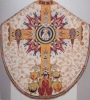
The Roman Catholic dioscese of Münster (Germany) was established in AD 804 and the building of the present Dom (cathedral) was commenced in the early thirteenth century. The Dom and its contents were badly damaged in the Second World War (1939-1945), and as a result it does not have the wide range of textiles and related items that can be found in other European cathedrals.

August Macke (1887–1914) was a German artist working in the early twentieth century. He was a member of the German Expressionist movement, and in particular that of Der Blaue Reiter ('The Blue Rider') group. He is well-known for gentle, daily-life subjects, such as women shopping for hats, scenes in parks, and so forth. August Macke died in September 1914 in France, shortly after the start of the First World War (1914-1918).
Mesh is an English language term that has several meanings when referring to netting:
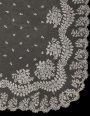
Brussels needlepoint lace is a form of needlepoint lace with a slight cordonnet with spaced buttonhole stitches. It was particularly popular in the eigheenth and early nineteenth centuries. The motifs were often applied on a droschel ground, replaced in the nineteenth century by three-twist Brussels net.