

Charles Frederick Cross (1855-1935) was an English chemist who helped to develop rayon and viscose. Cross was born in Brentford (England). He studied chemistry at King’s College London, the Zurich Polytechnic (Switzerland) and later at Owens College, Manchester (England).
Horace Arthur Lowe (1869-1930) was an English textile chemist from Heaton Moor, Lancashire (England), who played an important role in the development of mercerisation.
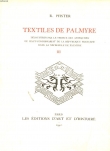
Rudolf Pfister (1867-1955; his official name was Jean Jost Rodolphe Pfister) was an Elzas born, French textile chemist and textile historian. In the first half of the twentieth century he analysed and published textiles from various Middle Eastern archaeological sites.

The throne canopy dates from 1916 and was first used by King George V of Great Britain (r: 1910-1936). It is made from red velvet and gilt wood and consists of the domed canopy itself surmounted by a crown, with a gilded wooden frieze. The draped upper part of the canopy is decorated with an applied, embroidered crown and further embellished with gold and silk tassels.
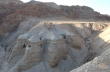
The site of Qumran (Khirbet Qumran) is located on an arid plateau along the northwestern shore of the Dead Sea, on the West Bank, Palestine, some twelve km south of Jericho. The settlement was constructed during the reign of John Hyrcanus (164-104 BC), a Hasmonean (Maccabean) leader. The village was destroyed by the Romans in AD 68.
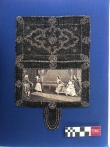
Dance cards (carnets de bal) were popular, female accessories in nineteenth and early twentieth century Western society. They were used to list the number of dances and the names of the associated dance partners at a ball or party. A full card indicated a popular girl, an empty card represented a social disaster.

Phineas Pett was a shipwright with close connections to the royal court in London. He was the son of shipwright Peter Pett and his second wife, Elizabeth Thornton. The National Portrait Gallery, London houses a portrait of Phineas Pett aged 43. Pett noted in his autobiography that in the autumn of 1612: "About this time my picture was begun to be drawn by a Dutchman working then with Mr. Rock at Rochester" (pp. 99-100).

Margaret Widdemer (1884-1978) was an American poet and novelist who first came to public notice with a poem called The Factories, which was about child labour. She won a Pulitzer Prize (actually, known at that time as the Columbia University Prize) in 1919 for her collection of poems entitled The Old Road to Paradise. Included among the poems (under the section Womenfolk) was one, simply called Embroidery.

The portrait of Margaret Graham, Lady Napier, is by the Dutch/Scottish artist, Adam de Colone (c. 1572-1651). He worked in the London and Edinburgh courts in the early seventeenth century and made various portraits of Scottish nobility. These portraits include two of Margaret Graham, sister of the 1st Marquess of Montrose and wife of the First Lord Napier (c. 1576-1645). She died shortly after the portrait was made, in 1626.

The 7th May 2015 was the date of General Elections in Great Britain. Tom Katsumi (1980) embroidered a map of the British Isles five days before the elections and then filled in the squares as the election results were being announced. The map was worked on white aida using cotton perlé in seven different colours, one each for the main political parties (blue = Conservative, red = Labour, etc).
More...
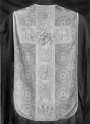
The catholic Sint Petrus church (St Peter), along the Lammenschansweg in Leiden, The Netherlands, holds a beautifully embroidered chasuble that dates from the first half of the sixteenth century and is attributed to Jan van Deinse, who was abbott in Boudelo, Flanders, between 1513 tot 1540. The chasuble was granted to the Sint Petrus church in 1919 by an unknown benefactor.

Handwerken zonder Grenzen ('Handwork without Boundaries') is a Dutch journal that, from September 1978, is published five to six times per year and includes articles about handwork techniques, in particular those that involve textiles. The articles deal with subjects that pertain to The Netherlands and beyond; tradition, folklore and history are the keywords.

There is a small number of passages in the Old Testament, which (may) refer to textiles and garments and some may allude to embroidered objects and the embroiderers themselves. For example, in Exodus 38:23: "And the Lord commanded Moses; and with him was Oholiab, the son of Ahisamach, of the tribe of Dan, a craftsman and designer and embroiderer in blue and purple and scarlet stuff and fine twined linen" (King James version; see also Exodus 35:35).

Nimrud is an ancient Assyrian city along the Tigris river, in northern Iraq. It was founded in the second millennium BC and remained occupied for about one thousand years. The ancient site is now known as Calah. In early 2015, much of the site was damaged by ISIS followers. The relevant textiles come from the 1988-1989 excavations directed by Muzahim Hussein, of the Iraqi Office of Antiquities and Heritage.