

The blanket and stem stitch is a composite stitch made up of a row of blanket stitches capped with a row of stem stitches. This form of stitch is normally used for free-style embroidery.
GVE
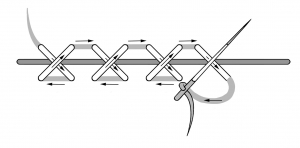
Couching with cross stitch is a composite stitch and a variation of couching, whereby detached cross stitches are used to fasten down the couching thread. This type of stitch can be used for both counted thread and free-style embroidery. This stitch should not be confused with the couched cross stitch.
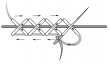
The trammed cross stitch is a variation of the cross stitch, whereby a series of cross stitches are worked over a thickish thread. The cross stitches should be worked very closely together. The tramming thread gives a padded effect while at the same time strengthening the cross stitching.

The couched cross stitch is a variation on a cross stitch, whereby a series of detached cross stitches is worked. The junction between the two elements forming the cross is fastened down. The same thread used to make the initial cross can be used, or a separate thread (usually in a contrasting colour).
See bi-coloured cross stitch. Also referred to as the chequered cross stitch.

The bi-coloured cross stitch is a variation on the cross stitch, in which yarns in two colours are used, one for each of the basic elements that form the cross. This type of stitch is used for both counted thread and free-style embroidery. It is sometimes known as a chequered/checked cross stitch. GVE

Underside couching is a technique whereby a thread (laid thread) is placed on the surface of the ground material, which is usually held taut in a frame. A second, usually finer thread (tying thread; couching thread) is brought up from the backside of the cloth and then used to encircle the laid thread. The tying thread is returned through the same hole and pulled gently until a loop of the laid thread appears on the back of the material.
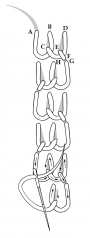
A chain and blanket stitch row is a composite stitch made from an open chain stitch and a blanket stitch. It is used for free style embroidery. GVE

The whipped chain stitch is a variation on the chain stitch, in which a row of chain stitches is worked and a second yarn is whipped around the stitches without entering the ground material. Also known as wrapped chain stitch.
More...

The zig-zag chain stitch is a variation on a chain stitch, except that each loop is made at an angle to the last one in order to create a zig-zag line.
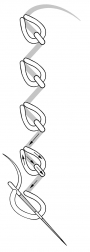
The slanting detached chain stitch is a variation on a detached chain stitch, in which the individual stitches are worked at an angle to an imaginary line, rather than in a straight line.
GVE