

The Cope of St Louis d'Anjou is a medieval garment now in the Basilica of Saint Marie Magdalena in the town of Saint-Maximin-la-Sainte-Baume, in the Provence-Alpes-Côte d'Azur region of southeastern France. The cope is closely linked to the history of the basilica, the construction of which started in the late thirteenth century, but it was never finished.
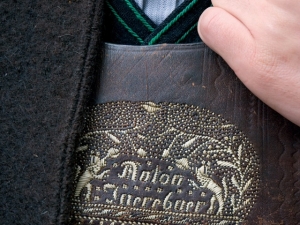
In some parts of southern Austria and neighbouring Italy (Tyrol), feathers are used as an embroidery thread to decorate a range of leather items. Male peacock feathers are stripped of the vane or feathery section, washed and dried. Then the hollow end (calamus, commonly known as the quill section) is cut into narrow strips. These strips are used to create initials, monographs, as well as small, intricate geometric patterns.

Evelyn Thomas (1951) is an English art historian who specialises in medieval English embroidery. Both of his parents were artists and his father taught Art at Eton College. Thomas studied art history at Edinburgh University (Scotland) and went on to an MA at the University of East Anglia.

"Opus Anglicanum - the Evelyn Thomas Database of Medieval English Embroidery" is the full title of a photographic index of English medieval embroidery, with an emphasis on opus anglicanum. The database is part of the Index of Christian Art (Princeton University), which was founded by Prof. Charles Rufus Morey (1877-1955) in 1917.
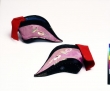
For many centuries, Han Chinese women used to bind their feet and put them into tiny shoes, generally called lotus shoes. There were various types of lotus shoes, such as day-time shoes and boots, wedding or bridal shoes, sleeping or night socks, separate heels, bad weather forms, gift shoes, mourning shoes, as well as funeral shoes.
Eanswitha was allegedly an embroideress from Hereford (England), who was granted 200 acres of farmland for the period of her life.

A tracing wheel is a needlework tool consisting of a wooden handle, with a shaped shaft (often of steel or, by the end of the twentieth century, made of plastic). At the end of the shaft is a rowel. A rowel is a metal disc with a series of sharp radial points and capable of rotation.